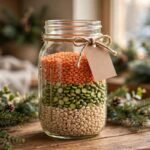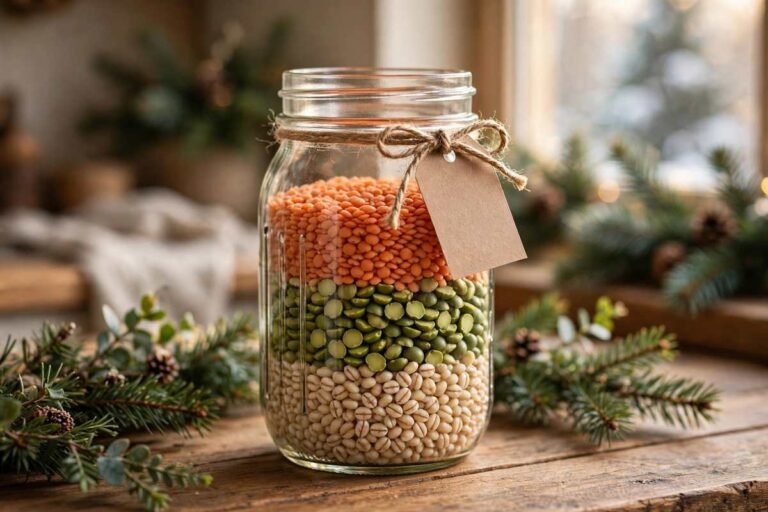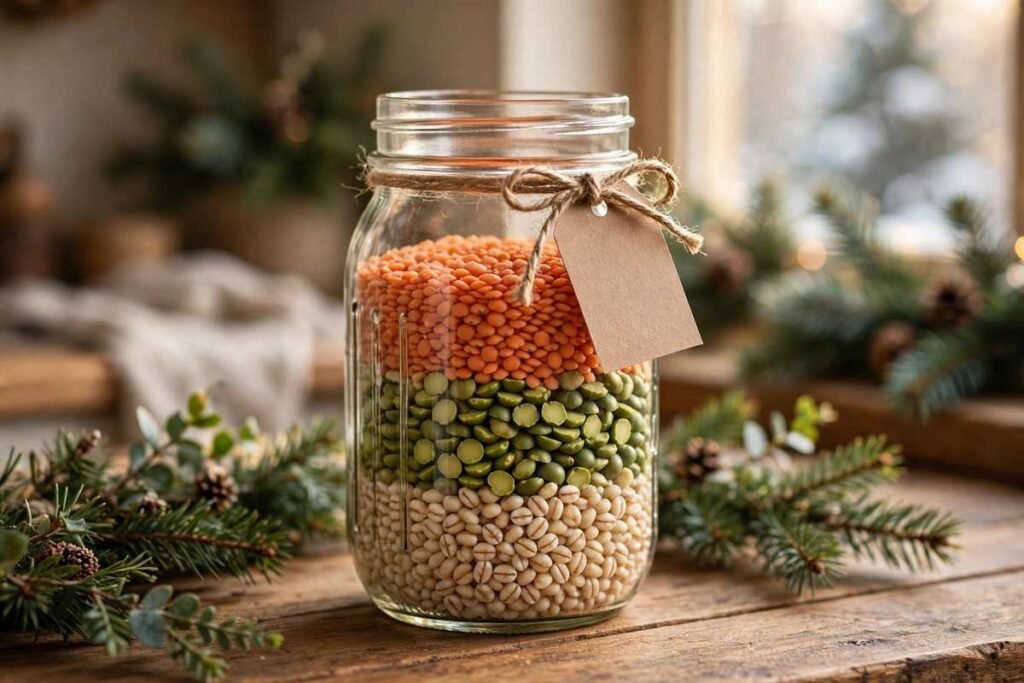
Soup mix in a jar is a quart jar of pearl barley, green split peas and red lentils, topped with a small bag of bouillon and dried herbs. It cooks in 35 to 40 minutes with 8 cups of water. One evening of filling gets six gifts out of it, and the person who opens one ends up with dinner.
I fill these for the teachers, the bus driver and the neighbor who takes in our packages. December asks for a lot of small presents, and the budget doesn’t grow to match. Grandma Florence put up green beans and tomatoes in jars every summer. Mine hold dry goods, but the habit came from her kitchen.
What Goes in the Jar
A quart jar holds four cups. This mix uses roughly 2.5 cups of dry goods. The pulses settle with air between them, so the layers take up more room than their cup measures suggest, and the jar still fills to the shoulder.
- Jar: one quart wide-mouth, 32 oz, washed and bone dry
- Layers: 1/2 cup each pearl barley, green split peas, red lentils
- Seasoning bag: 3 tbsp bouillon powder, 1 tbsp dried onion flakes, 1 tsp dried thyme, 1 tsp dried parsley, 1/2 tsp black pepper, 1 bay leaf
- Water to cook: 8 cups
- Simmer time: 35 to 40 minutes, until the barley is tender
- Serves: about six bowls
- Storage: months in a cool, dark cupboard; write the month on the lid
Bouillon powder beats cubes here, because it dissolves into the water instead of sitting in a lump at the bottom of the pot. You’ll find it in the soup aisle beside the stock cubes, or scoop it from a bulk bin. Brands differ a lot in salt, so taste the broth before you salt the pot at all.
Skip fresh garlic, fresh herbs and anything oily. All three bring moisture into a jar that’s got to stay bone dry, and garlic in oil carries its own well-documented risk. Dried is the point, not a compromise.
If your people would rather have dessert, the same layering works for a cookie mix in a jar or a hot cocoa mix. Those two go together in an afternoon, and nobody’s going to complain about a second jar of cocoa!
The Layer Order That Survives a Car Ride
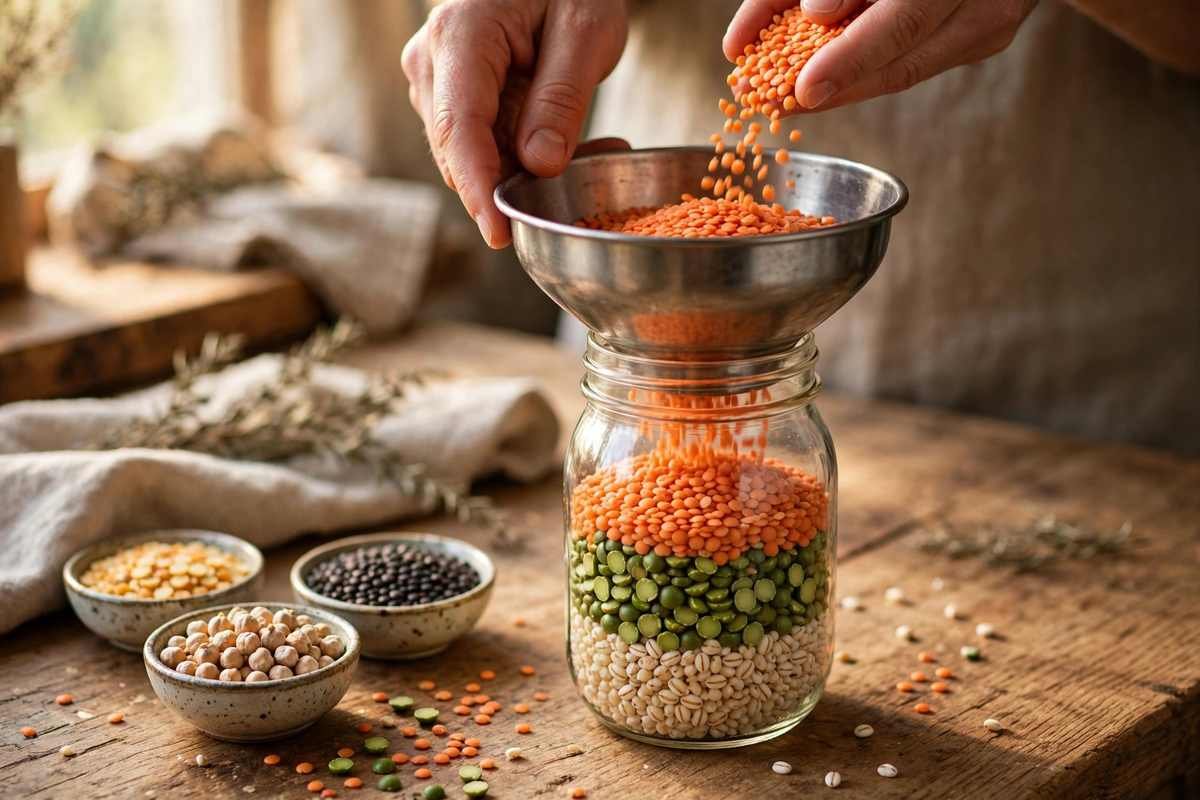
Pack the heaviest and densest layer first and work upward. Barley at the bottom, split peas next, lentils on top.
Alternate the colors as you go. The green peas sit against the orange lentils, and the stripes read through the glass from across a kitchen.
Pour through a folded paper funnel or a wide canning funnel, then tap the jar on the counter between layers. Tapping settles each one before the next lands, and that’s what holds the lines straight.
Stop an inch below the rim and tuck the seasoning bag on top. Press the bag flat so the lid closes against it. A bag standing upright won’t let the lid seat, and a lid that’s held off lets air and pantry smells in.
Order does more than decorate. A loose powder poured in first sifts down through the gaps in the pulses and turns the bottom layer gray. By the time the jar reaches the tree, it’s muddy. Sealed in its own bag, the seasoning stays where you can see it. The stripes are the gift wrap; the bag is what makes the wrapping hold.
Why This Soup Mix in a Jar Cooks in 35 Minutes
Every jar soup is timed by its slowest layer. Pearl barley needs 35 to 40 minutes of gentle simmering, green split peas run about the same, and red lentils fall apart in 15 to 20 and thicken the broth on the way. Nothing in this jar needs longer, so the tag says 35 to 40 minutes.
Most mix-in-a-jar recipes include dried beans, and that’s where the extra hour goes. Beans want 60 to 90 minutes, plus a hard ten-minute boil before you turn the heat down.
A jar with beans is still a fine gift. The tag just has to say 90 minutes and mention the boil. Skip that, and you’ll be chewing crunchy beans at eight o’clock!
Pasta stays out for a different reason. Starch keeps drinking the broth, and by the time the barley is tender the noodles have gone soft and taken most of the liquid with them.
“Always store the broth separately from the pasta. It will absorb over time.”
– r/mildlyinfuriating, October 2026 (4,274 upvotes)
How do you know the barley is done? Bite one grain. It’ll give under your teeth with a little chew left in the middle. It shouldn’t dissolve, and it shouldn’t crunch.
Salt goes in at the end, after you taste the broth. Bouillon powder is salty enough that an early spoonful can push a whole pot past the point of no return, and there’s no way to take it back out.
Want the cooked version instead of a dry mix? The tortilla soup recipe starts from a pot and a blender, not a jar.
The Tag Does Half the Gift
A jar with no instructions is a jar of dry goods. Five lines fix that.
You need the water, the time, salt at the end, the ingredient list, and the month you filled it. Write them in that order and your tag reads like a recipe card instead of a label.
Soup Mix in a Jar. Empty the jar into a 4-quart pot, add 8 cups of water, bring to a boil, then simmer 35 to 40 minutes. Salt at the end. Contains barley, split peas, lentils, bouillon (wheat, soy), onion, thyme, parsley, pepper, bay. Filled November.
That parenthesis earns its space. Bouillon cubes and powders often carry wheat or soy, and a gift that makes someone sick is worse than no gift at all. Write the brand on the back, in case they’d like to buy more.
Packaging doesn’t have to cost much: a kraft tag, cotton twine, and a square of fabric under the ring if you’d like it to look like more than it is. Skip the cinnamon stick and the dried orange slice unless you’ve dried them yourself. Wet garnish in a closed jar is a mold farm.
Three seasoning swaps keep six jars from tasting identical. Smoked paprika plus extra pepper makes a smoky one. Curry powder in place of the thyme makes a yellow one. Dried dill with lemon pepper makes a jar that suits fish stock. Each swap changes the bag only, so your layers and times don’t move.
Six Jars Without Losing a Saturday
Do the arithmetic once and your shopping gets simple. Six jars take 3 cups each of barley, split peas and lentils, and a one-pound bag of any of them holds about two cups. Two bags of each covers the batch with a cup or so to spare.
The seasoning multiplies the same way. Three tablespoons per jar is 18 tablespoons for six, which is 1 cup plus 2 tablespoons. Mix the whole batch in one bowl, then bag it into six small zip-top bags at the same time.
Set up three stations along the counter. Open jars on the left, the three bags of pulses in the middle, seasoning bags and lids on the right. That’s the whole system!
I scoop the barley and my kids do the lentils. It’s slow and messy, and it’s the only reason they care about the jars at all. Six jars take about 40 minutes once it’s all on the table.
Fill them the week you’re giving them, not in September. Keep the finished jars in a cupboard, not on a windowsill. Barley and bouillon lose their edge before the lentils do, so a jar is at its best in the first few months. A marker date on the lid tells the next person where they’re starting.
Before You Fill a Jar
How do you cook soup mix from a jar?
Empty the jar into a pot with 8 cups of water, bring it to a boil, then simmer 35 to 40 minutes until the barley is tender. Salt at the end. Nothing in this mix is a dried bean, so there’s no soaking step.
How long does soup mix in a jar keep?
A dry mix holds for months in a cool, dark cupboard, and it’s fine in the freezer for longer. Date the jar and use it within the season you gave it. Once it’s soup, refrigerate what you don’t eat and finish it within three to four days, per USDA’s FoodKeeper guidance.
Can you ship a jar of soup mix?
A quart jar ships fine when you tap the layers down and press the seasoning bag flat. Box it with padding on all sides and tape the lid. For long distances, you can send the mix in a food-safe bag instead of glass and tie the tag to the bag.
Related Posts



I love having dance parties in the kitchen with my family, traveling, and mason jar creations.
Follow on Pinterest