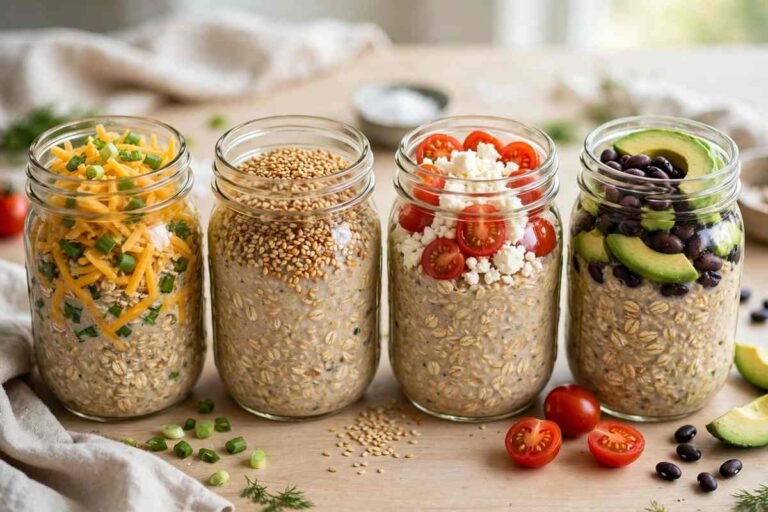
Savory overnight oats are rolled oats soaked overnight in broth or plain yogurt instead of milk, with salt and a savory topping. Ohio State University Extension says raw-oat dishes keep in the refrigerator for at least six hours and up to two days.
That sentence settles the storage question, and it is also where most recipes stop. What you need is a ratio you can repeat and four combinations that don’t taste like breakfast cereal with cheese stirred in. The method matches sweet overnight oats; only the liquid and the finish change.
I keep a row of pint jars on the bottom shelf for weekday mornings. The savory ones are what I reach for when the sweet versions start to feel like dessert at 7 a.m.
Savory Overnight Oats: The Base Ratio
The base ratio is 1/2 cup rolled oats, 2/3 cup liquid, and 1/4 teaspoon fine salt per pint jar. You can use chicken or vegetable broth for a deeper, rounder flavor, or plain unsweetened yogurt for a thicker and tangier jar. You don’t need a stove or a blender, just a jar and a spoon.
Old-fashioned rolled oats give the right texture. Instant oats go to paste, and steel-cut oats drink closer to a full cup of liquid and need a day and a half before they soften. Stick with rolled oats for your first jar. A wide-mouth 16-ounce jar leaves room to stir, and you’ll want that room for toppings.
- Jar: 16-ounce wide-mouth pint with a lid you can label
- Oats: 1/2 cup old-fashioned rolled oats
- Liquid: 2/3 cup broth, or 1/2 cup plain yogurt plus 2 tablespoons water
- Salt: 1/4 teaspoon fine salt, or 1/8 teaspoon when your add-ins are salty
- Chill: at least 6 hours and up to 2 days (OSU Extension)
Two-thirds of a cup of liquid looks like too much when you stir it. It isn’t. Rolled oats drink most of it overnight, and the jar sets to a spoonable thickness by morning. If yours still looks loose, give it another hour in the fridge.
Broth turns the jar into a soft risotto, especially with a spoonful of grated cheese. Yogurt keeps it thick and works better with tomatoes and herbs. Either way, salt is what makes the oats taste like food instead of wet grain, so don’t skip it. Taste the mix before it chills and add a pinch more if your oats need it.
If you go the yogurt route, my chia pudding with Greek yogurt uses the same thick base idea.
Keep your jar in the refrigerator from the moment you mix it. Broth and yogurt are perishable foods, and a jar on your counter is a different safety question than dry oats in a canister.
Four Jar Combinations
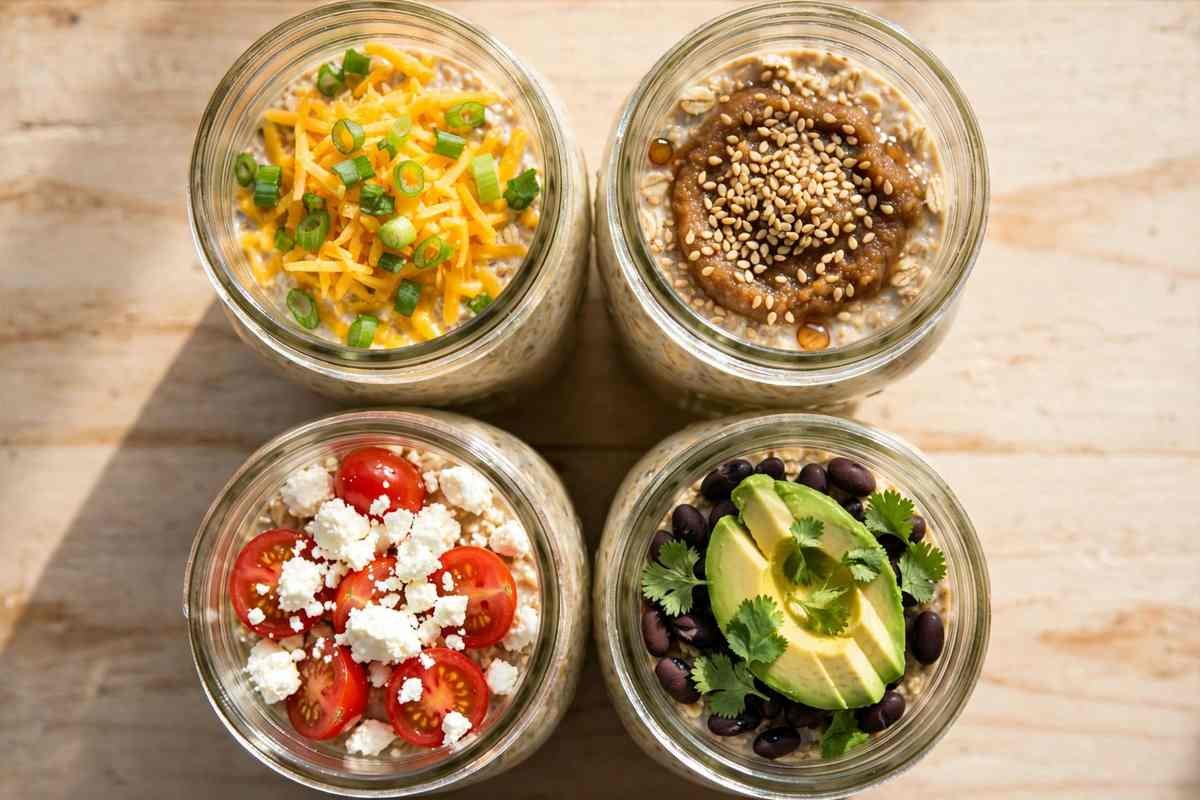
Each of these starts from the base ratio and adds three to five ingredients. Stir the savory add-ins into the oats before chilling and keep the crisp finish for the morning. You can mix the base in one bowl and divide it among the jars, which saves you four measuring rounds.
| Jar | Stir into the base | Add before eating |
|---|---|---|
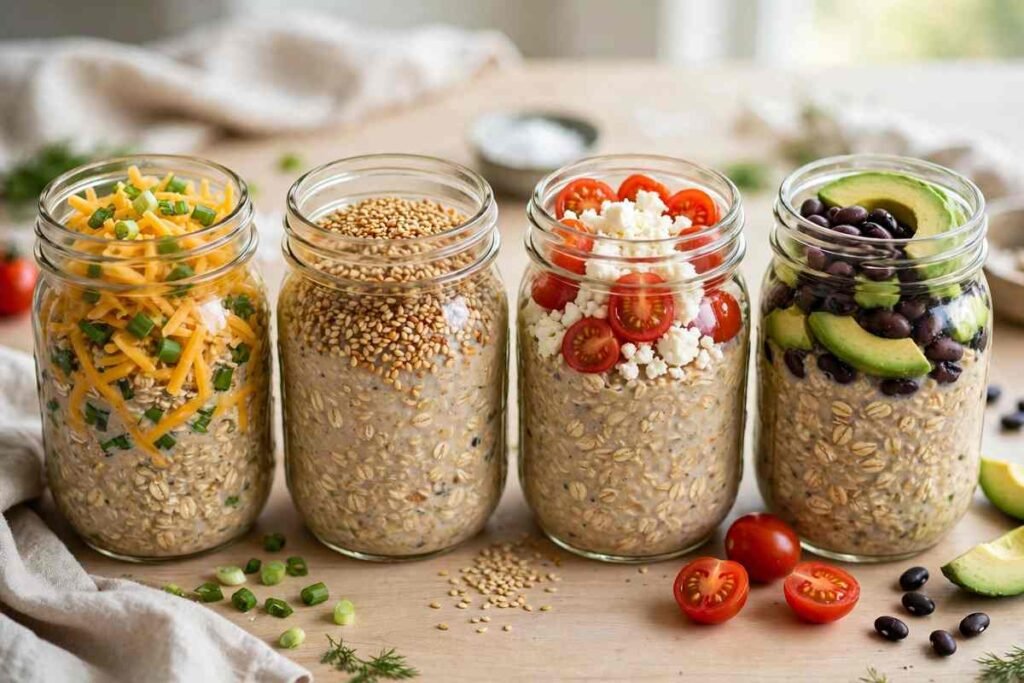
| Cheddar and scallion | 1/4 cup shredded sharp cheddar, 2 tablespoons sliced scallions, 1/4 teaspoon garlic powder | More cheddar and a crack of black pepper |
| Miso and sesame | 1 tablespoon white miso mixed into the liquid, 1 teaspoon toasted sesame oil, 1/2 teaspoon sesame seeds | Sliced scallion and chili crisp |
| Mediterranean feta and tomato | 1/4 cup crumbled feta, 6 cherry tomatoes halved, 1/4 teaspoon dried oregano, 1 tablespoon chopped olives | Diced cucumber, olive oil, black pepper |
| Mexican-style beans | 1/4 cup rinsed black beans, 2 tablespoons salsa, 1/4 teaspoon cumin, 1 tablespoon chopped cilantro | Avocado, lime juice, hot sauce |
Cheddar and scallion is the gateway jar, the one to make first. Sharp cheddar carries the salt. White or orange, both work. Cut the base salt to 1/8 teaspoon!
Miso and sesame tastes like a warm grain bowl that got left in the fridge on purpose. White miso is salty too, so taste before you add anything else!
It’s the jar I make in summer, when cherry tomatoes are at their best. The feta brings enough brine that your jar needs no extra salt.
Mexican-style beans turns the jar into a cold breakfast bowl. Rinse the beans well or the liquid goes cloudy and starchy.
Build each jar wet at the bottom and crisp on top, the way you would stack any Mason jar meal. The oats and add-ins go in first; cucumber, avocado, or extra cheese waits in a small container or goes on right before you eat. Crisp things go on last so they stay crisp.
“Oats, riced cauliflower, egg whites, nutritional yeast, spinach, salt, pepper, onion, garlic powder. Topped with spring onion, a soft boiled egg and avo!”
— r/Oatmeal, 646 upvotes
That thread runs on the same idea: treat the oats like a grain bowl and let the toppings do the rest.
You can eat these straight from the jar or tip one into a bowl. If you’re taking a jar to work, pack the crisp finish in a small container and add it at your desk.
Adding Eggs Safely
Cook the egg before it goes into the jar. That order matters! A cold soak never gets hot enough to cook raw egg, so boiled, jammy, or scrambled eggs go in at eating time, and the jar then follows the egg storage clock. That one rule keeps the whole breakfast safe.
University of Minnesota Extension treats prepared egg dishes as a three-to-four-day food and says to reheat them to 165°F. That rule covers a jar with cooked egg stirred in or piled on top. It doesn’t cover a raw egg cracked into cold oats on Sunday.
A jammy egg gives the best texture here: about six and a half minutes in boiling water, then straight into cold water. Peel it, halve it, and set it on the jar. Scrambled eggs work if you fold them in warm; a cold scrambled egg is rubbery. If you want the egg baked in instead, my bacon and eggs in a jar takes the oven route.
Eat Cold or Warm It Up
Savory overnight oats work cold, straight from the fridge, or warm. Cold, loosen your jar with a splash of broth or water until it stirs like a soft risotto. Warm, microwave in 30-second bursts. Stir between bursts, and add cheese or herbs after heating. You’ll get a better texture if you stir once more before you eat.
Cold is faster and the texture is denser. Warm brings out the cheese and the toasted sesame, and it feels more like a real breakfast on a cold morning. A small pot on low heat works too; add a splash of liquid and stir until it steams.
Take the lid off before the microwave and cover the jar with a paper towel, or the steam will pop. If the jar has egg, warm it all the way through to 165°F, not just until the middle is hot.
Storage
Plain savory jars keep two days in the refrigerator (OSU Extension). Jars with cooked egg follow the egg rule: three to four days, reheated to 165°F (UMN Extension). Label the lid with the day you made it so the two clocks don’t blur. Two clocks, one lid. Masking tape and a marker keep your days straight.
A Sunday batch works if you keep it small. Four jars means two days of plain jars plus two egg jars, which is about as far as the clocks allow. I don’t freeze these; the oats thaw grainy and the herbs go dark.
For the full timing chart on sweet and savory jars, see how long overnight oats last.
Savory Overnight Oats FAQ
Can overnight oats be savory?
Yes. You can swap the milk for broth or plain yogurt, add 1/4 teaspoon salt per jar, and finish with cheese, herbs, miso, or beans. The oats soften the same way; only the liquid and toppings change.
How do you make savory overnight oats?
Combine 1/2 cup rolled oats, 2/3 cup broth or thinned yogurt, and 1/4 teaspoon salt in a pint jar. Stir in your savory add-ins, refrigerate at least six hours, and add crisp toppings just before eating.
Do you eat savory oats cold or hot?
Either. Cold jars are thicker and faster; warmed jars taste more like a cooked grain bowl. Reheat egg-topped jars to 165°F.
Can I put a raw egg in overnight oats?
No. A cold soak doesn’t cook the egg, and raw egg in an uncooked jar is a risk I won’t take. Cook the egg first, then add it.
Can I use steel-cut oats?
Yes, with more liquid and more time. Use 1 cup liquid per 1/2 cup steel-cut oats and chill a full day; the texture stays chewier than rolled oats.
Can I make savory overnight oats without dairy?
Yes. Use broth plus a spoonful of olive oil or tahini instead of yogurt, and skip the cheese or use a dairy-free shred.
Can I add frozen vegetables?
Yes. Thaw them first and squeeze out the water, or your jar turns soupy. Spinach, peas, and roasted peppers all work, and you can’t rush the thaw in the microwave without cooking the edges.
Can I prep four jars at once?
Yes. Mix the base in one bowl, divide it among four pint jars, then stir a different combination into each.
How long do savory overnight oats last?
Two days for a plain jar (OSU Extension). Three to four days if it holds cooked egg, with reheating to 165°F (UMN Extension).
Related Posts




I love having dance parties in the kitchen with my family, traveling, and mason jar creations.
Follow on Pinterest