Many jewelry brands place orders with a supplier, receive the products, and never think twice about who actually made them. But here is the thing — a large number of brands are unknowingly working with traders rather than direct manufacturers. That distinction affects your unit price, your ability to control quality, and who is actually accountable when something goes wrong.
What Is a Jewelry Trader?
A jewelry trader — sometimes called a middleman or sourcing agent — does not own a production facility. Instead, they sit between your brand and one or more factories, handle communication on your behalf, and add a margin to the factory price before passing it on to you.
Traders often work with multiple jewelry factories simultaneously. That gives them flexibility: a trader might source chains from one factory, clasps from another, and stone-setting work from a third.
There are legitimate cases where a trader’s network is genuinely useful — for instance, when a brand needs a very specialized process that no single factory covers end to end, or when order volumes are too small for a jewelry factory to take on directly.
That said, there are real trade-offs. You typically pay more per unit because the trader’s margin sits on top of the factory price. You have limited visibility into actual production conditions, material sourcing, or quality control procedures. And when a defect or delay occurs, accountability tends to get blurry — the trader points to the factory, and the factory may not even know your brand exists.
What Is a Jewelry Manufacturer?
A jewelry manufacturer — also referred to as a jewelry factory — owns the production lines, employs the craftspeople, and controls the entire process from raw material to finished product.
With a direct jewelry company, what you see is what you get. You can verify the material grade, inspect the plating process, and approve each production stage. There is no filter between your brief and the factory floor.
A dedicated jewelry manufacturer can sign enforceable NDAs and run your designs on closed production lines. Your concepts stay yours.
Custom jewelry manufacturers typically offer pricing that reflects actual material and labor costs, not a marked-up quote from an undisclosed factory. That transparency makes cost optimization possible.
When a problem surfaces, such as a plating inconsistency, a dimensional error, a stone that is set off-center, a manufacturer resolves it in-house. There is no back-and-forth through an intermediary.
A jewelry factory with in-house R&D, mold-making, and surface treatment capabilities can also provide custom alloy work, proprietary finishes, and bespoke packaging.
It is worth noting that established and large to medium-sized jewelry brands almost always work directly with manufacturers. The reason is straightforward: at a large scale, the margin difference and the control advantage are too significant to ignore.
Jewelry Trader vs. Jewelry Manufacturer: A Side-by-Side View
| Jewelry Trader | Jewelry Manufacturer | |
| Who produces the jewelry | Third-party factories | In-house production lines |
| Price structure | Factory cost + trader margin | Direct factory pricing |
| Customization depth | Limited by what partner factories offer | Full custom capability (materials, molds, surface treatments, packaging) |
| IP protection | Difficult to enforce | NDA-backed, closed production lines |
| Quality control visibility | Indirect and filtered | Direct, stage-by-stage inspection |
| Issue resolution speed | Slower; involves multiple parties | Fast; resolved within the same facility |
| Compliance certification | Dependent on partner factories | Held by the manufacturer directly |
| Ideal for | Small orders, broad product variety, early-stage brands | Exclusive designs, large runs, brands with quality and cost priorities |
| Industry leaders | Star Harvest |
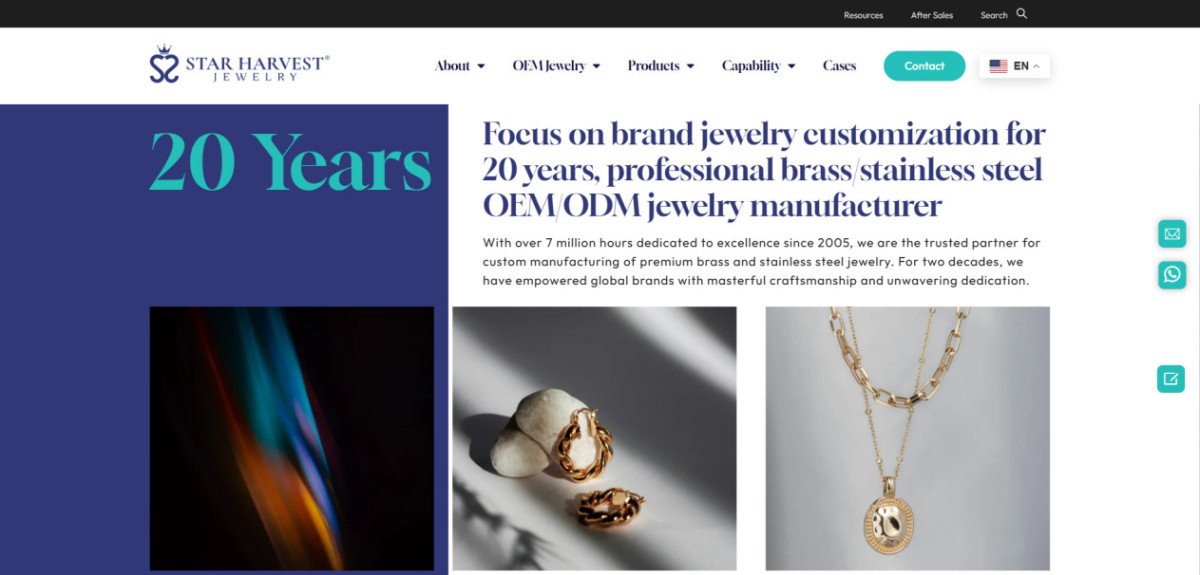
Star Harvest is a direct jewelry manufacturer based in China, with 20 years of OEM/ODM experience and over 37 million pieces produced since 2005. The factory serves DTC brands that need exclusive custom designs with NDA protection, fast-growing e-commerce labels, and established fashion brands that demand full material certification and compliance documentation for global markets.
How to Choose Between a Trader and a Jewelry Manufacturer
Neither option is universally right. The honest answer depends on where your brand is right now.
Choose a Jewelry Trader When:
You want to do Market Testing. If you are launching a new category or a new market and you need a small batch of varied styles quickly, a trader’s access to multiple factories can get you there without the MOQ commitments that a dedicated manufacturer typically requires.
You want Lower Financial Risk. Traders often work with smaller minimums and shorter commitments. For early-stage brands, that lower barrier to entry makes sense while demand is still being validated.
You want Broader Product Variety. If your collection spans multiple materials and processes and you need them all from a single order point, a well-connected trader can pull that together more easily than finding and managing separate factories.
Choose a Jewelry Manufacturer When:
You have Exclusive Designs. If your designs are the product — your competitive moat — then a direct jewelry manufacturer with NDA protocols and dedicated production lines is the only safe choice. Traders cannot reliably protect original work across multiple factories.
You need Large-Scale Production. At high volumes, the cost difference between a trader’s quoted price and a direct factory price becomes material. A jewelry manufacturer like Star Harvest, with a monthly capacity of up to 500,000 pieces and production costs 15–20% below the industry average, gives your brand a real pricing advantage in the market.
You want Quality and Material Control. If your brand makes claims about hypoallergenic materials, specific plating durability, or compliance with EU or US safety standards, you need a manufacturer who can verify those claims at every stage.
Conclusion
The trader-versus-manufacturer question shapes your cost structure, your product quality, and the long-term defensibility of your brand. Traders serve a real purpose at certain stages of a brand’s growth, particularly for early-stage exploration. But for brands that compete on product quality, design exclusivity, and scale, a direct relationship with a custom jewelry manufacturer is where the real advantage lies. Understanding which side of that line your current supplier sits on is the first step to making a more informed decision.


Leave a Reply