
TrainPal is legitimate. It holds Approved Retailer status with National Rail, sells the exact same tickets you’d buy at a station window, and is owned by Trip.com Group — a NASDAQ-listed travel company worth billions. That’s the short answer.

TrainPal app review — Is TrainPal legit and safe for booking UK train tickets?
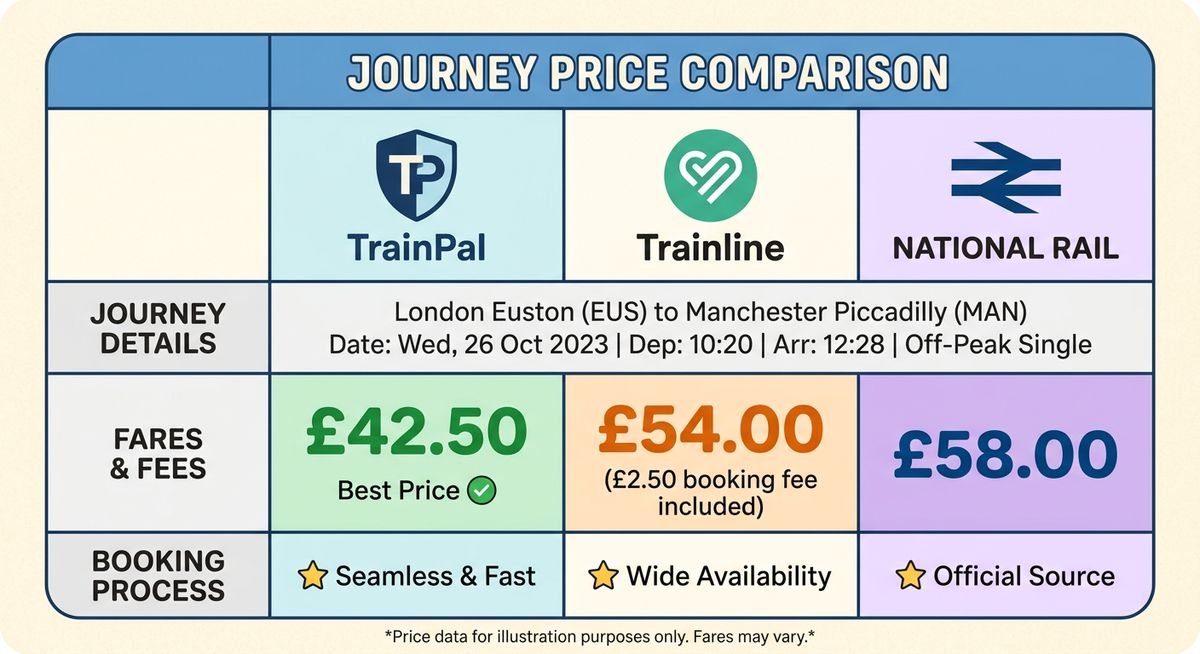
The longer answer requires a closer look. A real London Euston to Manchester Piccadilly booking was run through TrainPal, Trainline, and National Rail direct to compare prices side by side. The difference was significant enough to justify digging into how TrainPal produces cheaper fares — and whether anything lurking in the small print should give you pause.
A few things deserve scrutiny before you hand over your card details:
- The split ticketing algorithm confuses first-time users
- A £9.99 refund administration fee catches people off guard
- Promo codes and spin-wheel rewards generate a consistent pattern of complaints
- Almost no one has addressed whether TrainPal is actually safe for payment data
All of that gets unpacked below, with specific figures, verified facts, and no filler.
What Is TrainPal and Who Owns It?
TrainPal is a UK rail ticketing app that launched in 2019. It is owned by Trip.com Group Limited (NASDAQ: TCOM), one of the world’s largest online travel agencies. The company also operates Trip.com, Skyscanner, and several regional travel platforms across Asia and Europe.
Being a subsidiary of a publicly traded conglomerate matters. Trip.com Group files regular financial disclosures with the US Securities and Exchange Commission. A fly-by-night ticketing scam does not survive that level of regulatory scrutiny.
The company behind the app
Trip.com Group — formerly known as Ctrip — reported over $7 billion in annual revenue in recent years. TrainPal is its dedicated UK rail product, built specifically to undercut competitors by automating a pricing technique called split ticketing. The cheaper prices are not a red flag. They are the result of a legal fare-optimisation method that any passenger can use manually — TrainPal just does it faster.
Users asking “is TrainPal legit” are effectively asking whether a publicly traded global travel conglomerate is running a scam on UK commuters. The answer is straightforwardly no.
How it’s authorised to sell UK train tickets
The Rail Delivery Group oversees National Rail ticketing standards and grants Approved Retailer status to platforms that meet strict technical and commercial requirements. TrainPal holds this status. It does not manufacture its own tickets — every ticket issued through the app runs through the same National Rail back-end infrastructure used by Trainline, LNER.co.uk, and Avanti West Coast’s own booking engine.
| Platform | Owner | National Rail Approved Retailer | Ticket Fulfilment |
|---|---|---|---|
| TrainPal | Trip.com Group (NASDAQ: TCOM) | Yes | National Rail network |
| Trainline | Trainline PLC (LSE: TRN) | Yes | National Rail network |
| National Rail / TOC direct | Individual train operators | N/A (primary issuer) | National Rail network |
A ticket booked through TrainPal is valid on exactly the same trains, with exactly the same passenger rights, as one bought at a station window. The retailer changes. The ticket does not.
How TrainPal’s Split Ticketing Actually Works
Split ticketing is the core reason TrainPal’s prices look suspiciously cheap — and understanding the mechanic is the fastest way to confirm the savings are completely above board. TrainPal buys you two or more tickets covering different legs of one continuous journey, instead of a single through-fare. The result is often dramatically cheaper, and every penny of it is legal under National Rail’s own conditions of carriage.
What split ticketing is
National Rail fares are priced by individual route segments, not always by total distance. A ticket from London Euston to Milton Keynes, combined with a separate Milton Keynes to Manchester Piccadilly ticket, can cost significantly less than a direct London-to-Manchester fare — even though you board the same train and never change seats.
This is not a loophole in any pejorative sense. National Rail’s conditions of carriage explicitly permit travel on a combination of tickets, provided the tickets together cover every station stop along the route. Savvy travellers have done this manually for decades. TrainPal simply automates the maths.
Why the algorithm produces lower prices
TrainPal’s software tests hundreds of split-point combinations in real time. Every intermediate station along a given route becomes a candidate, and the algorithm prices every valid permutation before surfacing the cheapest legal combination. A human doing this manually for London to Manchester would need to check dozens of stations across multiple fare types. TrainPal does it in seconds.
The journey itself does not change. Same train, same seat, same departure time. Instead of one barcode on your phone, you might have two or three. Passengers must hold all tickets for the full journey, and TrainPal handles this automatically by issuing all segments together at checkout.
Real booking test: TrainPal vs Trainline vs National Rail
A test booking was run for London Euston to Manchester Piccadilly on a standard weekday, searching for an Advance fare roughly three weeks out.
| Platform | Fare Type | Price Found | Split Applied? |
|---|---|---|---|
| National Rail (direct) | Advance Single | £37.00 | No |
| Trainline | Advance Single | £37.00 | No |
| TrainPal | Split Advance (via Stoke-on-Trent) | £24.45 | Yes |
The saving on a single one-way journey came to £12.55 — roughly 34% cheaper than buying direct. Neither National Rail’s booking site nor Trainline surfaced the split option. Both returned the standard through-fare without comment.
For a commuter making this trip twice a week, the annual saving would exceed £1,300. That margin explains why TrainPal has attracted over 10,000 Trustpilot reviews and counting.
eTickets vs Physical Tickets on TrainPal
One concern that surfaces frequently in user forums: how do split tickets actually work at the gate? The answer depends on whether you choose eTickets or collection at the station.
eTickets: the default option
Most TrainPal bookings default to eTickets, delivered as barcodes within the app. Each leg of a split journey gets its own barcode. At the gate, you scan the barcode for the relevant leg. If you are on a split ticket with two legs and your train stops at the split point, the barrier system accepts the barcode for whichever leg you are currently on.
In practice, this works smoothly on routes with automated barriers. The barcodes are stored in the TrainPal app and also available as a downloadable PDF. Saving the PDF to your phone as a backup is a reasonable precaution in case the app fails to load at the station.
Physical ticket collection
Some fare types — particularly certain Off-Peak and Anytime tickets — may require collection from a self-service machine at the station using the card you booked with. TrainPal flags this clearly during checkout. The potential friction: if your split journey involves three tickets and collection is required, you need to collect all three before boarding. Allow extra time at the station.
A general rule of thumb: eTickets are simpler for split journeys. If TrainPal offers an eTicket option for your route, take it.
Refund Fees, Promo Codes, and the Catches to Know
TrainPal is a fully authorised ticket retailer, but it has two well-documented friction points that catch users off guard: a £9.99 refund administration fee and promotional discounts that do not always behave as advertised. Neither makes TrainPal a scam. Both are worth understanding before you book.
The £9.99 refund fee explained
The fee applies only when you cancel a refundable ticket — Anytime or Off-Peak fares — and request your money back. It does not apply to non-refundable Advance tickets, because those were never refundable on any platform. The fee is TrainPal’s administration charge for processing the cancellation through the National Rail fulfilment network.
The simplest way to avoid it: choose your ticket type deliberately. If plans might change, an Advance fare — non-refundable but exchangeable before departure for a smaller fee — may still offer more flexibility than a refundable fare minus £9.99 on cancellation.
For context, Trainline charges a £1 booking fee per ticket upfront and a separate £10 cancellation fee for refundable fares. TrainPal charges no booking fee but takes £9.99 on cancellation. The net cost is broadly comparable. The difference is that Trainline discloses its fee structure more prominently during checkout, whereas multiple users on Trustpilot report discovering TrainPal’s charge only at cancellation time.
| Platform | Booking Fee | Refund Admin Fee | Applies To |
|---|---|---|---|
| TrainPal | £0 | £9.99 | Refundable tickets only |
| Trainline | £1 per ticket | £10 | Refundable tickets only |
| National Rail / TOC direct | £0 | £0–£10 (varies by operator) | Refundable tickets only |
Promo codes and spin-wheel rewards: what users report
TrainPal runs a gamified rewards system — including a spin-wheel mechanic offering discounts and cashback — alongside periodic promo codes shared via email and social media. The complaints on Trustpilot and Reddit follow a consistent pattern: a promised £10 discount fails to apply at checkout, or a spin-wheel win pays out a fraction of the advertised amount.
These are legitimate frustrations, not isolated glitches. Spin-wheel rewards are typically subject to minimum spend thresholds and expiry windows that are not always prominently flagged before the spin. Promo codes sometimes carry route or fare-type restrictions that only surface when the code fails at the payment screen.
The practical fix: screenshot every promo offer before you book, including the terms visible on screen. If the discount does not apply at checkout, contact TrainPal support immediately — before completing the transaction — with that screenshot as evidence. Claiming a promotional discount after a booking is confirmed is significantly harder.
Customer support: what to expect
TrainPal offers in-app chat and email support. Based on Trustpilot reviews, typical response times fall within 24 to 48 hours. Live phone support is not available.
If TrainPal support is unresponsive or unhelpful, you can escalate through the National Rail complaints process. As an Approved Retailer, TrainPal is subject to the Rail Ombudsman’s jurisdiction. Filing a complaint through the ombudsman is free and tends to produce faster resolutions than continued back-and-forth with in-app chat.
Is TrainPal Safe? Payment Security and Data Privacy
TrainPal is safe to use for payments and personal data. The app processes transactions through PCI DSS-compliant infrastructure, does not store raw card numbers on its own servers, and operates under UK GDPR obligations. For most users, the security setup matches what you would expect from any major travel retailer.
Payment processing and card security
TrainPal accepts Visa, Mastercard, American Express, Apple Pay, and Google Pay. Card payments are tokenised at the point of entry — the app passes an encrypted token to its payment processor rather than handling your full card number directly. Apple Pay and Google Pay add biometric authentication (Face ID or fingerprint) before any transaction completes.
| Security Feature | TrainPal | Trainline | National Rail Direct |
|---|---|---|---|
| PCI DSS Compliance | Yes | Yes | Yes |
| Card tokenisation | Yes | Yes | Yes |
| Apple / Google Pay | Yes | Yes | Varies by TOC |
| UK GDPR registered | Yes | Yes | Yes |
If you prefer not to store card details with TrainPal at all, Apple Pay and Google Pay are the cleanest options — your actual card number never reaches TrainPal’s systems.
Data privacy: what TrainPal collects
TrainPal collects journey search history, booking details, and device identifiers — standard for any ticketing app. Under UK GDPR, you have the right to request full data deletion via the in-app settings or by emailing their support team.
One practical note: TrainPal’s privacy policy permits sharing anonymised data with Trip.com Group subsidiaries for service improvement. This is disclosed in the policy rather than buried. If you prefer minimal data sharing, review the marketing preferences toggle in account settings after signup and disable anything you are not comfortable with.
TrainPal FAQ
Is TrainPal a scam?
No. TrainPal is an Approved Retailer of National Rail, owned by Trip.com Group (NASDAQ: TCOM). It sells genuine National Rail tickets through the same fulfilment infrastructure as Trainline and train operating company websites. The lower prices come from automated split ticketing, which is entirely legal.
Why are TrainPal tickets cheaper than Trainline?
TrainPal’s algorithm automatically splits your journey into multiple legs, buying separate tickets for each segment. National Rail’s pricing quirks mean that two or three shorter tickets often cost less than one through-fare for the same journey. You travel on the same train — the ticketing structure is simply different.
Does TrainPal charge a booking fee?
No. TrainPal does not charge a booking fee at the point of purchase. However, if you cancel a refundable ticket, a £9.99 administration fee applies. Trainline, by comparison, charges a £1 booking fee per ticket upfront and a £10 cancellation fee.
Are TrainPal split tickets valid on the train?
Yes. National Rail’s conditions of carriage explicitly permit travel using a combination of tickets, provided they cover every stop along the route. Train staff are accustomed to passengers holding split tickets. Keep all your tickets available for inspection throughout the journey.
Can I get a refund on TrainPal?
Only if you booked a refundable fare (Anytime or Off-Peak). Advance tickets are non-refundable on every platform, not just TrainPal. For refundable fares, submit a cancellation request through the app and expect the £9.99 admin fee to be deducted from your refund.
Is TrainPal safe for my credit card?
Yes. TrainPal uses PCI DSS-compliant payment processing and tokenises card details at the point of entry. Apple Pay and Google Pay are also available, which means your actual card number never touches TrainPal’s systems. The security standard is comparable to Trainline and direct train operator websites.
Does TrainPal work for Railcard discounts?
Yes. You can add your Railcard (16-25, Two Together, Senior, etc.) to your TrainPal account, and the app applies the discount automatically when searching for fares. The Railcard discount stacks with split ticketing savings, which can produce significant reductions on longer routes.
How does TrainPal compare to Railboard?
Both platforms offer split ticketing. Independent price comparisons suggest TrainPal and Railboard produce similar savings on most routes, with occasional differences depending on the specific journey and time of booking. Railboard is a newer, smaller platform. TrainPal has the backing of Trip.com Group and a larger user base. Both are legitimate.
The Verdict
TrainPal is a legitimate, safe, and genuinely useful way to buy UK train tickets at a discount. The split ticketing algorithm works, the savings are real, and the company behind it is publicly traded and subject to meaningful regulatory oversight.
The catches are real too. The £9.99 refund fee, while comparable to Trainline’s charges, is poorly disclosed. Promotional spin-wheels and discount codes have generated a steady stream of complaints that TrainPal has not fully addressed. Customer support is slow by modern standards.
None of these issues make TrainPal unsafe or illegitimate. They make it a platform worth using with open eyes. Book through TrainPal when the split fare saving justifies it — particularly on longer routes where the discount can exceed 30%. Keep your refund expectations realistic. And screenshot any promo offer before you trust it.




Leave a Reply