
Did you know the world’s largest rodent is also its most sociable? The capybara, a gentle giant from South America, has become an unlikely global icon. It is famous for its zen-like calmness and its tendency to befriend nearly every animal it meets — from birds to monkeys to the occasional caiman.
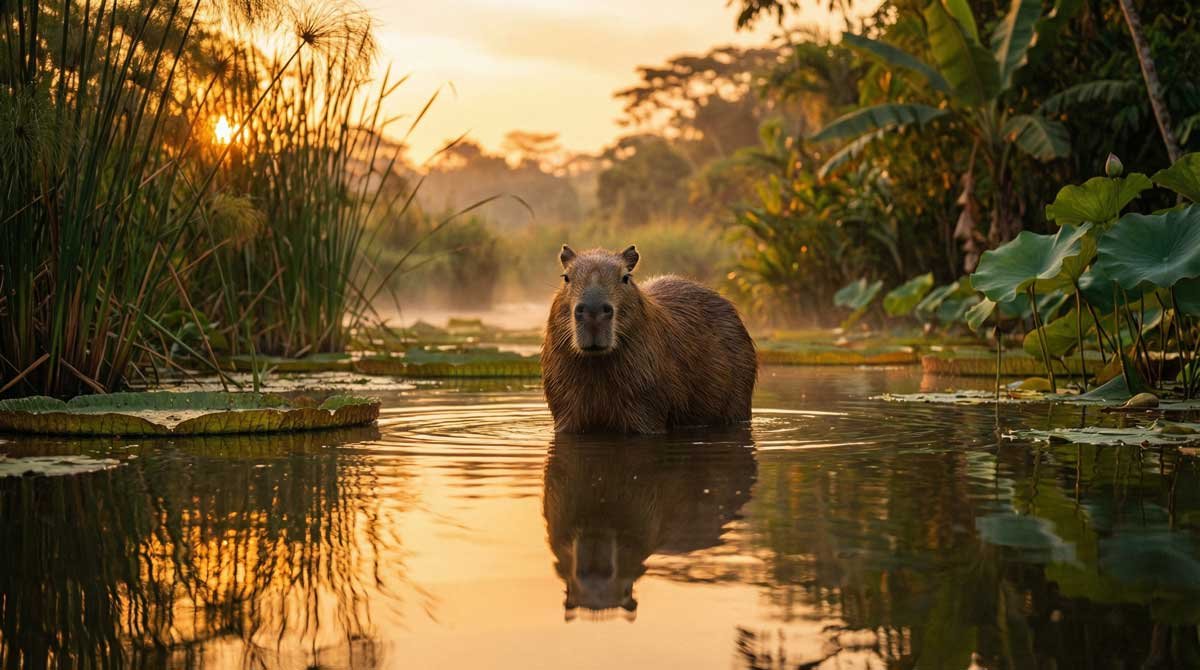
The capybara in its natural habitat — a South American wetland at golden hour.
But there’s far more to this creature than cute memes. This guide goes beyond the basic facts. We’ll explore the science behind their incredible chill, uncover their bizarre history involving the Catholic Church, and dive into exactly how they conquered the internet.
Get ready to understand the capybara on a whole new level. From its unique biology to its surprising cultural impact, you’ll discover what makes this animal so genuinely special.
What is a Capybara? The Gentle Giant Explained
The capybara (Hydrochoerus hydrochaeris) holds the undisputed title of the world’s largest living rodent. More closely related to guinea pigs and rock cavies than to rats, this impressive mammal is a master of the semi-aquatic lifestyle. They are a true spectacle of nature’s design.
With a heavy, barrel-shaped body and a short, blunt head, its appearance is unmistakable. The reddish-brown fur is long and somewhat brittle, perfect for drying out quickly after a swim. Their feet are slightly webbed — four toes on the front, three on the back — making them powerful swimmers and capable walkers on soft, muddy ground.
Native to the wetlands, forests, and savannas of South America, this giant rodent is found in every country on the continent except Chile. It is never far from water. Rivers, lakes, and marshes serve as both a food source and an escape route from predators like jaguars and anacondas. It can stay completely submerged for up to five minutes, often with just its eyes, ears, and nostrils peeking above the surface like a living periscope.
As strict herbivores, their diet consists mainly of grasses and aquatic plants. An adult can consume 6 to 8 pounds (2.7 to 3.6 kilograms) of vegetation every single day. In a fascinating, if slightly off-putting, biological quirk, these animals are autocoprophagous. They eat their own feces in the morning to extract maximum nutrients and essential gut bacteria, helping them digest the tough cellulose in grass — a strategy that is far more efficient than it sounds.
Capybara at a Glance
| Feature | Detail |
|---|---|
| Scientific Name | Hydrochoerus hydrochaeris |
| Average Length | 106–134 cm (3.5–4.4 ft) |
| Average Weight | 35–66 kg (77–146 lbs); record: 91 kg female in Brazil |
| Lifespan | 8–10 years in the wild; up to 12 years in captivity |
| Diet | Herbivore (grasses, aquatic plants, fruit, bark) |
| Habitat | Wetlands, forests, and savannas of South America |
| Conservation Status | Least Concern (IUCN Red List) |
The Science of Zen: Why Are Capybaras So Calm?
The internet is filled with images of capybaras looking completely unbothered — often while other animals sit on them. This remarkable calmness isn’t just a personality quirk; it’s a finely tuned survival strategy rooted in their biology and social structure.
First, these animals are intensely social. They live in groups of 10 to 20 individuals, and during the dry season, herds can swell to 100 or more as they gather around shrinking water sources. This group dynamic provides safety in numbers. With many eyes watching for danger, each individual can afford to be more relaxed. Collective vigilance reduces the stress on any single member.
Their primary defense mechanism is not fight, but flight — or rather, freeze and float. When a threat is detected, the first instinct is to become still or slip silently into the water. This lack of aggressive response projects an aura of tranquility. Energy is conserved by avoiding unnecessary conflict, a key trait for a prey animal that must remain alert without burning out.
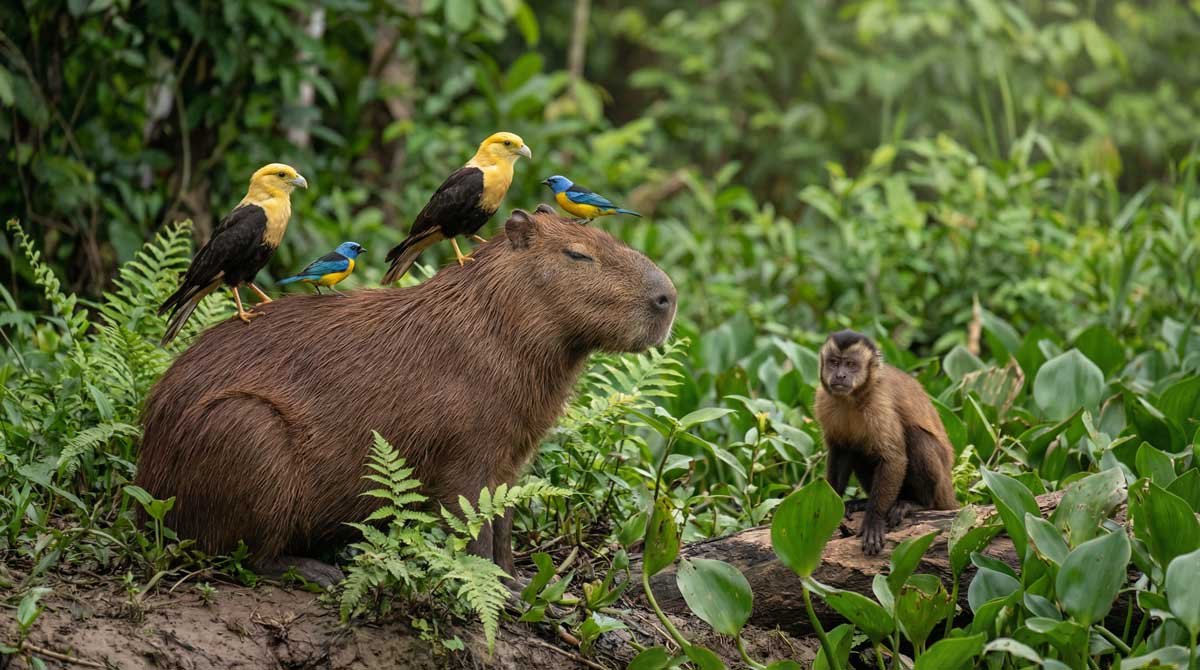
The capybara’s calm demeanor makes it a trusted companion for birds, monkeys, and many other species.
This placid nature has made them the animal kingdom’s favorite armchair. Birds, monkeys, and even other members of the herd are often seen resting on their backs. This is a form of mutualism: birds pick parasites from the fur, providing a cleaning service in exchange for a meal and a safe perch. Their non-threatening presence makes them a stable, trustworthy anchor in their ecosystem — a living island of calm in a world full of predators.
These giants also communicate through a rich vocabulary of sounds — barks, chirps, whistles, huffs, and purrs. This sophisticated system helps the group coordinate without chaos, further reinforcing their reputation as the most socially harmonious rodents on Earth.
An Unlikely Star: How the Capybara Conquered the Internet
In the early 2020s, the capybara made a remarkable leap from South American wetlands to global internet superstardom. Its rise is a fascinating case study in what the internet truly craves: something calm, wholesome, and genuinely weird.
The capybara’s unflappable demeanor made it the perfect symbol of zen in a chaotic world. Memes proliferated showing them in absurd situations, looking completely serene. A particularly popular format paired capybara footage with the song “After Party” by Don Toliver, creating a hypnotic loop of calm that resonated with millions of stressed-out viewers. The message was clear: be the capybara.

Japan’s Izu Shaboten Zoo pioneered the tradition of capybara hot spring baths, creating iconic viral imagery.
Their fame was amplified by a unique Japanese tradition. The Izu Shaboten Zoo began giving its capybaras outdoor hot spring baths (onsen) during winter, a practice that started decades ago and has since become a beloved seasonal event. Videos of these blissful rodents soaking in steamy water, eyes half-closed in contentment, went viral globally and cemented their image as the ultimate icons of relaxation.
Adding yet another layer to their legend, a 2021 incident in Argentina saw capybaras invade Nordelta, an exclusive gated community built on their natural wetland habitat. The internet jokingly framed the event as a grassroots uprising — the original residents reclaiming their land. The capybara, entirely unbothered, became an ironic and humorous symbol of class struggle.
The result? A TikTok song, countless plush toys, and a cultural moment that shows no sign of fading. The capybara didn’t try to go viral. It simply was itself, and the internet came to it.
The Surprising History and Human Interaction
The capybara’s relationship with humans stretches back centuries, marked by a particularly strange historical footnote. In the 16th century, Venezuelan clergy faced a dilemma: what could their congregations eat during the meat-restricted period of Lent? They observed the capybara’s semi-aquatic nature and sent a petition to the Vatican.
In a remarkable ruling, the Catholic Church classified the capybara as a fish due to its time spent in water. This allowed it to be consumed during Lent. To this day, salted capybara meat — known locally as chigüire (pronounced chee-GWEE-reh) — remains a traditional Holy Week dish in Venezuela and parts of Colombia. It’s a surprising piece of history that highlights the animal’s deep cultural roots in South America, long before it became a meme.
More recently, the capybara’s internet fame has sparked interest in keeping them as pets. However, this is a serious undertaking. While legal in some US states like Texas and Pennsylvania, ownership is prohibited in others like California and Georgia. The costs are substantial — expect to pay $1,000 to $5,000 per animal from a reputable breeder. And that’s just the beginning.
Capybaras require a large, fenced outdoor area with a substantial pool for swimming, as their skin dries out without regular access to water. As highly social animals, they must be kept in pairs or groups — a solitary capybara is an unhappy capybara. Their diet requires fresh grass and vitamin C-fortified pellets, as they cannot synthesize vitamin C on their own, just like guinea pigs.
Capybara vs. Other Large Rodents
| Feature | Capybara | Beaver | Nutria (Coypu) |
|---|---|---|---|
| Average Weight | 35–66 kg (77–146 lbs) | 16–32 kg (35–70 lbs) | 5–9 kg (12–20 lbs) |
| Social Structure | Highly social (large herds) | Monogamous pairs/families | Colonial; can be solitary |
| Tail | Vestigial (almost none) | Large, flat, paddle-like | Long, rounded, rat-like |
| Primary Diet | Grasses, aquatic plants | Tree bark, leaves, cambium | Aquatic plant roots and stems |
| Webbed Feet | Partially webbed | Fully webbed (hind) | Partially webbed |
Frequently Asked Questions About Capybaras
- 1. Why are capybaras so friendly with other animals?
- Capybaras have a calm and non-aggressive nature primarily because they are highly social prey animals. Their main defense is stillness or retreat to water, not confrontation. This placid demeanor makes them non-threatening to other species. Many animals, like birds and monkeys, seem to recognize this and use them as a resting spot. Birds also eat parasites from their fur, creating a genuinely mutually beneficial relationship that looks, to us, like friendship.
- 2. Can you legally own a pet capybara?
- The legality of owning a pet capybara varies greatly by country and by state or province. In the United States, they are legal in states like Texas and Pennsylvania but prohibited in others like California and Georgia. They are demanding pets, requiring large spaces, a pool of water, the companionship of at least one other capybara, and a specialized diet that includes vitamin C supplementation. The initial cost per animal typically ranges from $1,000 to $5,000.
- 3. What does a capybara eat?
- Capybaras are herbivores whose diet consists mainly of grasses and aquatic plants. They are selective eaters, often focusing on just three to six plant species. A fascinating part of their diet is autocoprophagy — they eat their own feces to better digest tough cellulose in grass and absorb maximum nutrients and gut bacteria. An adult capybara eats approximately 6 to 8 pounds of vegetation per day.
- 4. Are capybaras dangerous to humans?
- Capybaras are generally not dangerous to humans. They are shy and will typically flee if they feel threatened. However, like any wild animal, they can bite if cornered, scared, or provoked. Their large front teeth can cause serious injury, so it is always best to treat them with respect and observe them from a safe distance, especially in the wild.
- 5. How did the capybara become a meme?
- The capybara became an internet meme due to its incredibly calm and sociable nature. Viral images and videos show them looking completely unfazed in all sorts of situations, often with other animals resting on them. This serene vibe became a symbol of being “chill” in a chaotic world, frequently paired with the song “After Party” by Don Toliver. The trend was further boosted by iconic videos of capybaras relaxing in Japanese hot springs, creating a global image of pure, untroubled contentment.
More Than a Meme: The Enduring Appeal of the Capybara
From biological marvel to cultural icon, the capybara has captured the world’s imagination in a way few animals ever do. It is far more than a passing internet trend. The capybara represents a unique combination of gentle strength, social harmony, and an enviable, zen-like approach to existence.
Its story is a reminder of the fascinating and often bizarre ways animals and humans intersect. A creature classified as a fish by the Vatican, beloved in Japan for its love of hot springs, and turned into a symbol of class struggle in Argentina — the capybara contains multitudes. And through it all, it remains completely, magnificently unbothered.
We encourage you to support conservation organizations working to protect the vital wetland habitats that capybaras and countless other species depend on. If you’d like to see one in person, visiting an accredited zoo or wildlife sanctuary is the most responsible way to do so. The capybara, in all its calm glory, is well worth the trip.
References



Leave a Reply