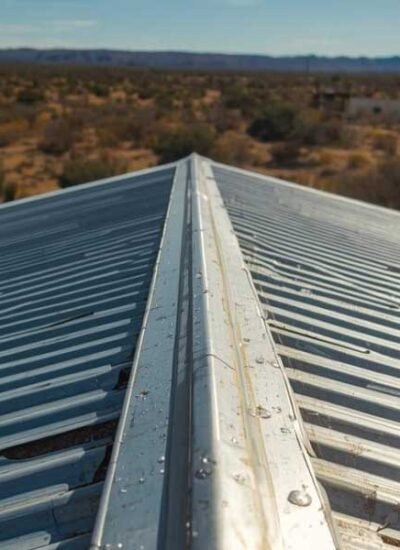
A metal roof that leaks is almost never leaking because the metal itself has failed. The metal panels are a continuous waterproof surface that will shed water for 40 to 70 years if they are not punctured by a fallen branch. The leak is at a penetration, a seam, a flashing, or a fastener — the places where the continuous metal surface is interrupted by something passing through it, joining to an adjacent panel, or transitioning to a different material. Every metal roof leak can be traced to one of four categories: failed fasteners, separated seams, broken flashings, or installation errors that were built into the roof on day one.
The most frustrating metal roof leak is the one that appears to have no cause — the ceiling is wet, but the roof looks perfect from the ground. That leak is almost always a fastener with a failed neoprene washer, a snap-lock seam that has opened by a fraction of an inch, or a flashing joint where the sealant has separated from the metal on one side. All three are invisible from the ground and require a close inspection on the roof surface to find.
What Causes Metal Roof Leaks by Roof Type
| Roof Type | #1 Leak Cause | #2 Leak Cause | #3 Leak Cause |
|---|---|---|---|
| Exposed-Fastener (Corrugated / R-Panel) | Failed neoprene washers (80%) | End lap sealant failure | Ridge cap / transition flashing |
| Standing Seam (Snap-Lock) | Seam separation from thermal cycling | Penetration flashing (pipe boots) | Wall-to-roof transition flashing |
| Standing Seam (Mechanical) | Penetration flashing failure | End closures at eave/ridge | Transition flashing sealant |
| Metal Shingle / Tile | Interlocking joint failure | Valley flashing corrosion | Penetration flashing |
1. Failed Fasteners and Neoprene Washers
On an exposed-fastener metal roof, the screws that hold the panels to the roof deck are the most common leak source by an overwhelming margin — roughly 80% of leaks on these roofs trace to a fastener. Each screw has a neoprene washer under the head that seals the screw shaft to the metal panel. UV radiation degrades the neoprene over 10 to 15 years. The washer cracks, shrinks, and loses its seal. Water seeps down the screw shaft, through the panel, and into the roof deck.
The fastener itself looks intact from the ground. The washer failure is visible only from inches away — the washer looks dull, cracked, or flattened rather than plump and pliable. Press your thumb against it: if it feels hard and brittle rather than rubbery, it has failed. Replacing a single failed fastener costs $5 to $15 if you do it yourself (the screw costs $0.50; the rest is the trip to the hardware store and the ladder time). Replacing all the fasteners on a roof as a preventive measure costs $300 to $600 in labor and materials and extends the roof’s life by 10 to 15 years.
Not all leaks at fasteners are the fastener’s fault. If the screw was over-driven during installation — tightened so far that the washer is squeezed flat and the metal panel is dimpled around the screw head — the washer was destroyed on day one. The leak that appears at year 5 was caused by the installer at year zero. An over-driven screw creates a depression in the panel that holds water around the screw head, accelerating both washer degradation and panel corrosion.
2. Seam Separation from Thermal Expansion and Contraction
Steel expands and contracts with temperature — roughly 1/16 inch per 10 feet of panel length for every 100°F temperature change. A 20-foot standing seam panel in a climate with a 100°F annual temperature swing grows and shrinks by 1/8 inch every year. Over 20 years, the panel has moved a total of 2.5 inches back and forth — not all at once, but in thousands of small thermal cycles.
Snap-lock seams rely on the spring tension of the formed metal to hold the two panel edges together. That spring tension fatigues over decades of thermal cycling. The seam opens by a fraction of an inch — not enough to be visible from the ground, but enough for wind-driven rain to blow through. The panels look perfectly joined from a distance. Up close, the gap is visible at the seam line.
Mechanical seams — formed on-site with a seaming machine that physically folds the two panel edges together — do not suffer from this failure mode. The folded joint cannot separate without being physically unfolded. A mechanical-seam roof that leaks at a seam was either improperly seamed during installation (the machine was not calibrated, the fold was incomplete) or the panel itself has torn at the seam from wind uplift that exceeded the panel’s design load.
3. Flashing Failures at Penetrations and Transitions
Every pipe, vent, chimney, skylight, and wall-to-roof junction on a metal roof is sealed by a flashing assembly — a combination of metal and sealant that bridges the gap between the continuous roof surface and the penetration. Flashings fail when the sealant degrades, the metal corrodes, or the flashing was installed incorrectly.
Pipe boot failure: The rubber collar around a plumbing vent cracks from UV exposure over 10 to 20 years. The crack is always at the point where the collar grips the pipe — the point of maximum tension. Replacing the pipe boot costs $200 to $500.
Step flashing and counter-flashing failure: At a wall-to-roof junction, the step flashing directs water down the roof. The counter-flashing prevents wind-driven rain from blowing behind the step flashing. When the counter-flashing sealant degrades or the metal lifts out of the chimney mortar joint, water enters behind the entire flashing assembly. The ceiling stain appears on the floor below the wall — often two stories down — and the leak source at the roof-to-wall junction looks perfectly intact.
Valley flashing corrosion: The metal in a roof valley handles more water than any other component. If the valley metal is galvanized steel rather than Galvalume, aluminum, or copper, it will rust through at the bottom of the V-channel — the point of maximum water contact and debris accumulation — in 20 to 30 years. The shingles or panels on either side of the valley look fine. The valley metal underneath has rusted through.
4. End Lap and Overlap Failures
Metal roof panels come in standard lengths — typically 10 to 20 feet — and long roof planes require multiple panels joined end-to-end. The joint where the upper panel overlaps the lower panel is called an end lap. The overlap must be at least 6 inches, and the seam between the two panels must be sealed with butyl tape or a bead of sealant across the full width of the panel.
End lap failures occur when the overlap is too short (the installer cut corners to save material), the sealant was omitted or applied incorrectly, or ice damming at the eave forces water uphill under the lap. An end lap leak in the middle of a roof face produces a ceiling stain that is directly below the lap — water enters at the lap and drops straight down through the deck with minimal lateral travel because there is no seam to carry it sideways.
5. Condensation: Not a Leak, But Looks Like One
Condensation on the underside of a metal roof is not a leak, but it produces the same symptom — water dripping from the ceiling. It occurs when warm, moist interior air contacts the cold underside of the metal deck and the water vapor condenses into liquid. The water appears as uniform droplets or frost across a wide area of the deck, not as a concentrated drip at a single point.
Condensation is most common in unheated buildings — barns, workshops, garages — and in houses with cathedral ceilings where the insulation was installed directly against the underside of the metal deck without a ventilation channel. The fix is ventilation, not roofing: a ridge vent and soffit vents that allow air to circulate under the metal deck, or a vapor barrier on the warm side of the insulation to prevent interior moisture from reaching the cold metal.
If the dripping appears on sunny days after a cold night, and no rain has fallen, it is condensation. If the dripping appears only during or immediately after rain, it is a leak.
6. Installation Errors: Leaks Built Into the Roof on Day One
A significant percentage of metal roof leaks — perhaps 30% to 40%, based on contractor surveys — are caused by errors made during the original installation. The roof leaked from day one, or would have leaked if the first heavy rain had hit at the right angle. The most common installation errors:
- Fasteners in the wrong location. Screws driven through the flat of the panel on a standing seam roof (instead of through the concealed clip flange), or screws driven through the rib of a corrugated panel at the bottom of the corrugation instead of the top. Water flows in the low points; a screw at the bottom of a corrugation sits in standing water after every rain.
- Missing or reversed overlap. An end lap where the upper panel is tucked under the lower panel directs water into the seam rather than over it. A valley metal seam with the upper section under the lower section does the same thing.
- Wrong fasteners. Carbon steel screws on an aluminum roof create a galvanic corrosion cell. The aluminum corrodes around the screw hole and the hole enlarges until the washer can no longer seal it. Stainless steel fasteners are required for aluminum and copper roofing, and when working with copper systems it’s equally important to source compatible materials from reputable copper suppliers to help avoid galvanic corrosion and long-term performance issues.
- No sealant at critical joints. Butyl tape or urethane sealant is required at end laps, ridge caps, and penetration flashings. If the installer skipped the sealant to save time, the roof will leak at those joints — not immediately, but within the first 2 to 5 years as the metal surfaces oxidize and the bare metal-to-metal contact loses whatever minimal water seal it initially provided.
When to Repair vs. Replace a Leaking Metal Roof
A single leaking fastener, a failed pipe boot, or a separated seam on an otherwise sound metal roof is a repair. Multiple leaking fasteners across the entire roof face, widespread seam separation on a snap-lock roof, or rust-through at the panel surface mean the roof is approaching the end of its service life. The threshold for repair vs. replacement is roughly 30% of the roof surface affected — if more than a third of the fasteners, seams, or panels have failed, replacing the roof costs less per year of remaining service life than chasing individual leaks.
An exposed-fastener roof with widespread washer failure can sometimes be saved by replacing all the fasteners — a $300 to $600 preventive repair — rather than replacing the panels. A snap-lock roof with widespread seam separation cannot be repaired seam by seam. The spring tension that held the seams closed has fatigued, and tightening one seam shifts the panels enough to open the adjacent seams. The only permanent fix is to replace the snap-lock panels with mechanical-seam panels.
FAQ: Common Questions About Metal Roof Leaks
Can a metal roof rust through and leak?
Yes, but it takes decades. Galvalume steel in a non-coastal environment will not rust through for 40 to 60 years. Galvanized steel in a wet climate may rust through at the cut edges — the eaves, the gable ends, around fastener holes — in 25 to 35 years. The rust-through is always at a cut edge, a scratch, or a fastener hole — the factory-coated face of the panel does not rust unless the coating was defective. A metal roof that has rusted through in the middle of a panel is either extremely old or was made from uncoated steel, which is not a roofing-grade product.
Can I use silicone to seal a metal roof leak?
Yes, as a temporary repair lasting 1 to 3 years. A bead of high-quality exterior-grade silicone or urethane sealant applied to a leaking fastener head, a small seam gap, or a flashing joint will stop the leak temporarily. It is not a permanent fix. The proper permanent repair depends on the cause: a new screw and washer for a failed fastener, butyl seam tape for a separated seam, a new pipe boot for a cracked collar, or a new flashing assembly for a failed transition. Silicone is the bridge to the permanent repair, not the repair itself.
Metal Roofs Leak at Interruptions, Not at the Metal
The seven causes — failed fasteners, separated seams, broken flashings, end lap failures, condensation, installation errors, and age-related corrosion — all share one pattern: the leak is at a place where the continuous metal surface is interrupted. The broad expanse of painted steel or aluminum between the ridge and the eave is not leaking. The screw through that steel, the seam between two panels, or the flashing where the roof meets a wall is leaking.
If your metal roof is leaking, go into the attic and look at the underside of the deck. Follow the water stain to its highest point. On the roof above that point, you will find a fastener, a seam, or a flashing — and one of them is the problem.



Leave a Reply