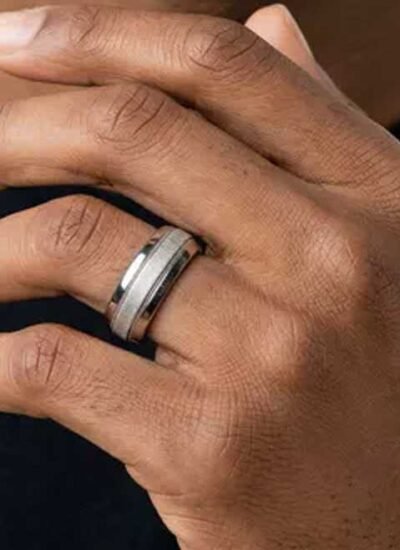
The Wedding Band Regrets Men Talk About a Year Later — and How to Avoid Every One
Ask a married man about his wedding band and you’ll get one of two answers. Either he forgets he’s wearing it, which is the goal, or he has a small, specific complaint he’s been carrying quietly since the honeymoon. The complaints are remarkably consistent, and every one of them traces back to a decision made too fast at the very end of wedding planning.
The good news is that the regrets are predictable, which means they’re avoidable. Here are the ones that come up again and again, and how to sidestep each.
“I bought it last, in a rush”
The band is almost always the final purchase, chosen after months of energy have already gone into the engagement ring, the venue, and everything else. By the time it’s the band’s turn, the appetite for decisions is gone, and the ring gets picked in an afternoon from whatever’s in the case.
The fix costs nothing: move the decision earlier. Give it an evening of real attention a couple of months out, while there’s still patience for it, rather than a hurried yes in the final week. Browsing a few distinctive makers early — somewhere like Aquamarise — is enough to shift the band from an afterthought to a decision. A ring worn for decades deserves more than the dregs of your planning energy.
“It looked great in the photo and wrong on my hand”
Product photography flatters every ring equally. A band shot on a white background gives no sense of how it sits on a real finger, and width in particular reads completely differently in a photo than in person. A profile that looks refined online can vanish on a broad hand or overwhelm a slender one.
The safeguard is to judge proportion against something physical. Look at what he already wears comfortably — the weight of his watch, any ring he owns now — and use that as the reference. A ring chosen to suit the actual hand almost never disappoints; one chosen from a screen often does.
“I didn’t think about what I do all day”
This is the quiet one. A man picks a finish he likes without considering that he spends forty hours a week doing something hard on his hands, and a few months in the ring doesn’t look the way it did on day one. Sometimes that’s fine — plenty of men grow to like the softened, lived-in look. But when it’s a surprise, it reads as damage rather than character.
The move is to decide this on purpose rather than by accident. Think honestly about his week and choose a surface that either wears gracefully or resists wear, depending on which he’d prefer. A textured or matte finish hides the small marks of daily life; a high polish shows them. Neither is wrong — but it should be a choice, not a discovery.
“We matched too hard”
Some couples pick perfectly identical bands and one of them spends years wishing they hadn’t. Matching for the sake of matching can leave one partner with a ring that was really chosen to coordinate rather than because they loved it.
The contemporary answer is a shared thread instead of a matched pair — the same texture across two different profiles, a common inner engraving, a shared accent stone set differently in each ring. The rings clearly belong together, but neither person compromised their own taste to get there. Independent workshops tend to be the best source for this, since they’ll happily build two coordinated-but-different rings rather than only selling matched sets. Ranges of distinctive men’s rings from smaller makers are built around exactly that kind of flexibility, which is where a lot of the “belongs together without being identical” work happens.
“I played it so safe the ring is boring”
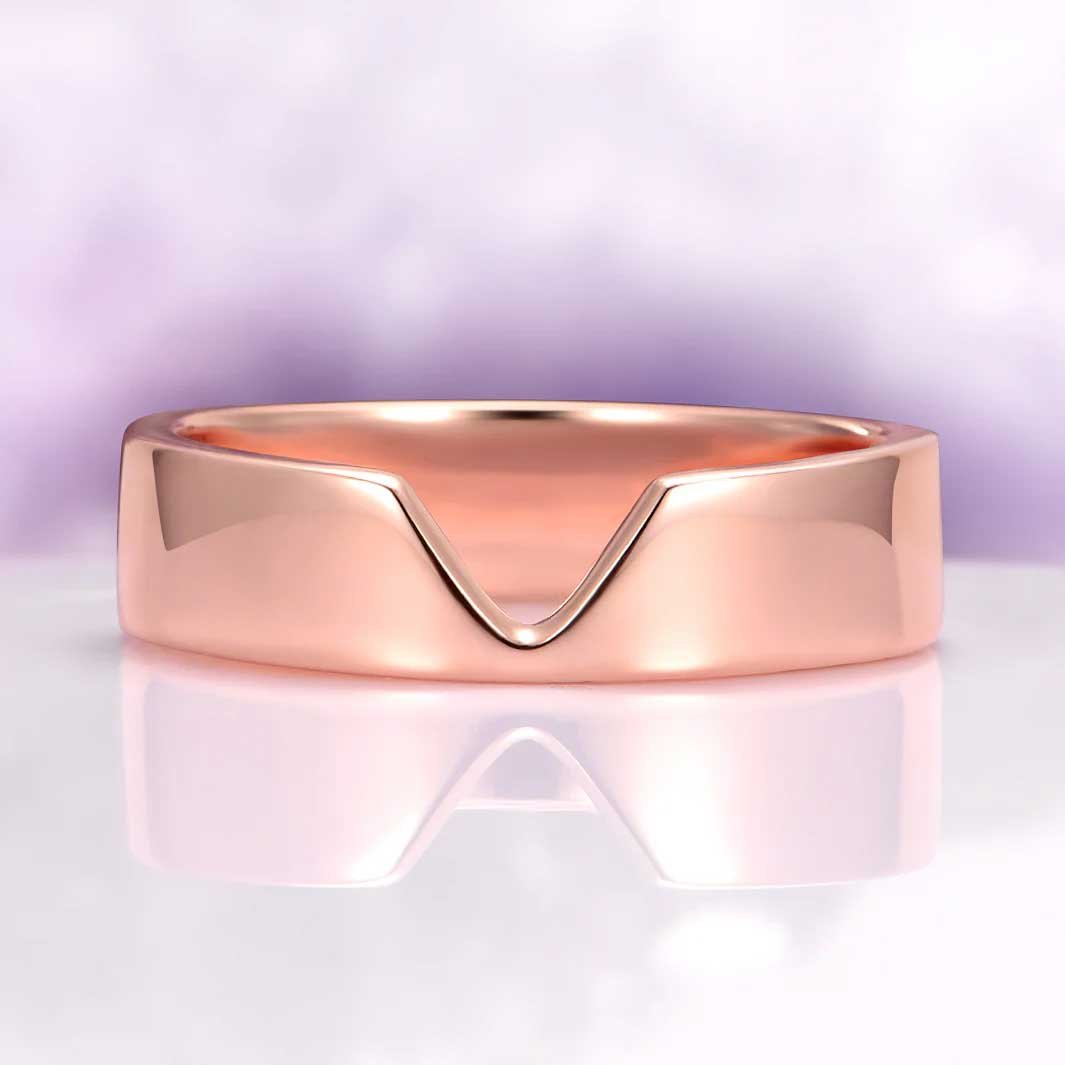
A chevron profile — a small departure from the plain band that gives the ring character without shouting.
The most common regret of all isn’t about metal or fit. It’s the man who defaulted to the plainest option in the case and realized a year later he’d have liked something with a little character. Plain bands are genuinely timeless, but timeless and forgettable are not the same thing, and a man who quietly admires more distinctive rings should give himself permission to choose one.
The design vocabulary is wide now — textured and hammered surfaces, carved and sculptural forms, nature-inspired detailing, discreet set stones. None of it has to shout. The point is simply to choose a ring he actually likes looking at, rather than the least objectionable circle on the tray.
“I left no time for it to be right”
Anything made to order takes production time, and any ring may need an adjustment once it’s on the hand — fingers change with heat, cold, and time of day. The man who orders with no margin turns a routine tweak into a pre-wedding emergency.
Build in a comfortable runway before the date. If the ring is being commissioned rather than pulled off a shelf, add more still — the back-and-forth is where a custom band actually becomes his, and it can’t be rushed.
The pattern behind all of them
Every one of these regrets comes from treating the band as an afterthought — decided last, chosen from a screen, picked without thought for his real life, and ordered with no time to spare. Reverse those four habits and the regrets simply don’t materialize. Give the ring an evening of genuine attention, judge it against his actual hand and his actual week, let his real taste show, and leave time for it to be made right.
The standard to aim for is simple: a band he forgets he’s wearing, and notices only when it’s not there. That outcome is almost never an accident — it’s the result of a decision made with a little more care than the calendar seems to allow.


Leave a Reply