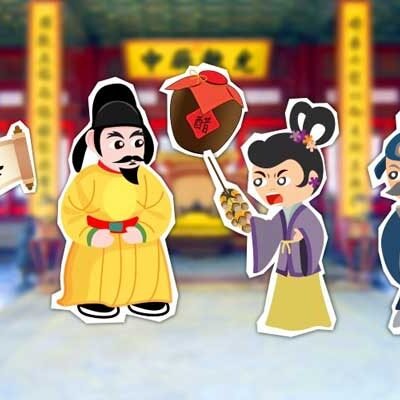
If you are working with an online Chinese teacher or using a platform to learn Mandarin online, you will encounter the expression 吃醋 (chī cù) relatively early in your studies. Its literal meaning is straightforward: chī means to eat, and cù means vinegar. Its actual meaning, however, is “to feel jealous” — specifically the jealousy associated with romantic rivalry. The expression is used casually and frequently in contemporary Chinese, appearing in conversation, television drama, social media and literature alike. What most learners are not told is that behind this apparently simple expression lies a specific historical story involving one of the most powerful men in Tang dynasty China, his notoriously jealous wife, and an emperor who decided to test just how far that jealousy actually went!
The story centres on Fang Xuanling (房玄龄), one of the most celebrated statesmen of the early Tang dynasty and a principal architect of the administrative system that made the reign of Emperor Taizong one of the most successful in Chinese history. Fang Xuanling served as chief minister for over twenty years and was considered by Taizong to be among the most capable and loyal officials in the empire. He was also, by all historical accounts, completely dominated by his wife, Lady Lu, whose jealousy was so intense and so well known at court that it had become a subject of both concern and private amusement among those around the emperor.
The situation came to a head when Emperor Taizong, in accordance with the customs of the imperial court, decided to reward Fang Xuanling’s decades of loyal service by sending him two court ladies as concubines. This was a standard imperial gift of the period, a mark of favour that a senior official was expected to receive with gratitude. Fang Xuanling, fully aware of what his wife’s reaction would be, found himself in the impossible position of being unable to refuse an imperial gift without causing serious offence to the emperor and unable to accept it without triggering consequences at home that he apparently feared considerably.
Emperor Taizong, hearing of this domestic impasse, decided to resolve it directly. He summoned Lady Lu to the palace and presented her with a choice. She could accept her husband’s new concubines gracefully, as befitted the wife of a senior imperial official, or she could drink from a cup that the emperor placed before her, which he told her contained poison. The implication was unambiguous: her jealousy was incompatible with her position, and if she was unwilling to control it, the alternative was death. Lady Lu, according to the historical account, looked at the cup, looked at the emperor, and without hesitation picked it up and drank the contents without flinching.
The cup, as the emperor then revealed, contained not poison but vinegar. Taizong had been testing her resolve rather than genuinely threatening her life, and what the test demonstrated was that Lady Lu’s jealousy was stronger than her fear of death. She would rather drink what she believed to be poison than accept a rival for her husband’s affections. The emperor, reportedly caught between admiration and exasperation, acknowledged that there were forces in the world beyond even imperial authority, and the matter of the concubines was quietly dropped.
The story passed into Chinese cultural memory and eventually produced the expression 吃醋. To eat vinegar is to be so consumed by jealousy that you would drink poison rather than yield, with the vinegar standing in for the poison of the original story and the act of consuming it standing in for the experience of jealousy itself. The expression retains no trace of its origin in casual contemporary use — a person who says their partner is 吃醋 is simply noting jealousy in a relationship, with no awareness of Lady Lu or Emperor Taizong required. But the story behind it is considerably more vivid and human than the expression’s surface simplicity suggests, and knowing it transforms a vocabulary item into a window into Tang dynasty court life, gender dynamics and the limits of imperial power.
This is precisely what makes chéngyǔ and historically rooted expressions worth studying beyond their definitions. Some Chinese language teaching institutions like GoEast Mandarin in Shanghai approach vocabulary of this kind through its cultural and historical sources rather than through definition alone, on the basis that a learner who knows the story of Lady Lu and the vinegar cup will never forget 吃醋, while a learner who has only memorised its definition as “to be jealous” has acquired something considerably more fragile. The richness of Chinese idiomatic language is, in this sense, not an obstacle to learning but an asset — provided the stories are told.




Leave a Reply