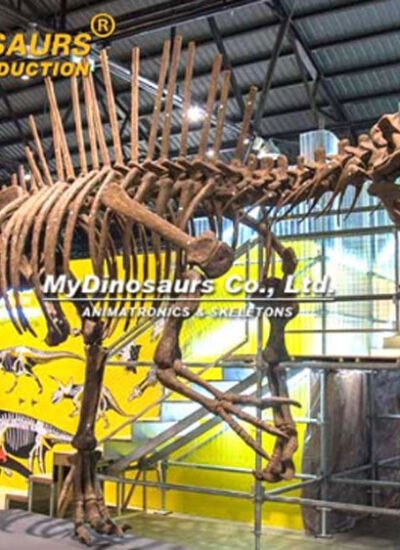
 Why do some dinosaurs capture the imagination more than others? While the Tyrannosaurus rex often takes the spotlight as the “king of dinosaurs,” another prehistoric predator has fascinated scientists and the public alike: the Spinosaurus skeleton. With its crocodile-like snout, towering sail, and semi-aquatic lifestyle, Spinosaurus stands out as one of the most unusual dinosaurs ever discovered.
The journey to understanding this enigmatic creature has been marked by destruction, rediscovery, and debate. Since the early 20th century, each fossil find has added new layers of intrigue, reshaping our understanding of how this dinosaur lived, hunted, and thrived millions of years ago. Today, Spinosaurus remains a symbol of both scientific challenge and wonder.
Image from My Dinosaurs
The Discovery of the Spinosaurus
The story of Spinosaurus began in 1912, when German paleontologist Ernst Stromer uncovered partial remains in Egypt’s Bahariya Oasis. Stromer recognized the uniqueness of this dinosaur, but unfortunately, the original fossils were destroyed during a World War II bombing in Munich in 1944. This loss left paleontologists with only Stromer’s notes and sketches for decades.
In the late 20th and early 21st centuries, new discoveries in North Africa—particularly in Morocco and Algeria—began to fill in the gaps. These finds included parts of the skull, tail, and limb bones, providing fresh insights into the dinosaur’s anatomy and lifestyle. Each new fossil discovery reshaped long-held assumptions, fueling debates about whether Spinosaurus was primarily a land-based predator, a swimmer, or a hybrid of both.
Unique Features of the Spinosaurus Skeleton
The Spinosaurus skeleton is unlike any other known dinosaur. Several distinct features stand out:
- Elongated snout: Similar to a crocodile, its long jaws were lined with conical teeth designed to grip slippery prey like fish.
- Sail-like structure: Its most iconic feature, the “sail,” was formed by elongated neural spines protruding from its vertebrae.
- Dense bones: Unlike most theropods, Spinosaurus had compact, dense bones, suggesting it adapted to life in water.
- Tail built for swimming: Recent fossil evidence revealed a broad, paddle-like tail, strengthening the argument that it was semi-aquatic.
| Feature | Possible Function |
| Long Snout & Teeth | Suited for catching fish and aquatic prey |
| Back Sail | Potential display, thermoregulation, or storage |
| Dense Bones | Buoyancy control for underwater stability |
| Paddle-like Tail | Propulsion for swimming |
Together, these adaptations suggest Spinosaurus was the first known dinosaur capable of thriving both on land and in water, setting it apart from its terrestrial relatives like T. rex and Giganotosaurus.
Scientific Debates and Theories
Despite significant fossil evidence, scientists continue to debate the mysteries of the Spinosaurus skeleton.
1. The Purpose of the Sail
The function of the sail remains hotly debated. Some hypotheses suggest it helped regulate body temperature by absorbing or dissipating heat. Others argue it may have been a display structure—used to attract mates or intimidate rivals. A third theory proposes it stored energy or fat, similar to a camel’s hump.
2. Semi-Aquatic Lifestyle
Recent discoveries suggest Spinosaurus was the first truly semi-aquatic dinosaur. Its dense bones reduced buoyancy, and its tail functioned like a paddle, giving it swimming ability. However, skeptics argue that adaptations may not have been sufficient for full aquatic life, suggesting it spent much of its time along riverbanks and shallow waters rather than deep swimming.
3. Hunting Strategies
Unlike other theropods that hunted large land-based prey, Spinosaurus likely relied on fish and aquatic animals. Its nostrils were positioned higher on its head, allowing it to breathe while partially submerged. This, combined with its conical teeth and strong bite, suggests it was a stealthy hunter waiting for prey at the water’s edge.
Why the Spinosaurus Captivates the Public
Spinosaurus has earned a place not just in scientific research but also in popular imagination.
- Pop Culture Presence: Spinosaurus has appeared in films, documentaries, and books, often portrayed as a rival to the T. rex. Its on-screen presence cemented its reputation as one of the most formidable predators in history.
- Museum Exhibits: Life-sized reconstructions of the Spinosaurus skeleton in museums around the world inspire awe and curiosity, drawing millions of visitors.
- Educational Value: Teachers and science communicators use Spinosaurus as an example of how scientific knowledge evolves with each new discovery, making it a powerful teaching tool.
The combination of mystery, size, and uniqueness has made Spinosaurus a dinosaur that continues to inspire both children and adults.
Ongoing Research and Future Discoveries
The fascination with the Spinosaurus skeleton extends into modern science, where new discoveries continue to reshape understanding.
- New Fossil Excavations: In Morocco, ongoing digs have revealed more complete tails and vertebrae, strengthening the case for a semi-aquatic lifestyle.
- Digital Reconstruction: Using CT scans and 3D modeling, researchers can digitally reconstruct damaged bones, creating more accurate skeletons.
- Paleoenvironmental Studies: By studying surrounding rock formations, scientists learn about the ecosystem Spinosaurus lived in—an environment rich in rivers and aquatic prey.
- Comparative Anatomy: By comparing Spinosaurus bones to modern crocodiles and aquatic reptiles, researchers better understand how it moved and hunted.
Future discoveries may answer unresolved questions: Was the sail primarily decorative or functional? Could Spinosaurus chase prey underwater, or was it a slow ambush predator? Every new fossil adds to this evolving story.
Why the Spinosaurus Skeleton Still Matters Today
The enduring fascination with Spinosaurus highlights broader themes in science:
- Resilience of Knowledge: Even though original fossils were destroyed, scientists have rebuilt knowledge piece by piece through persistence and new technology.
- Evolving Science: Spinosaurus demonstrates how scientific understanding is never static—it shifts as new evidence emerges.
- Inspiration for Learning: Its mysterious adaptations encourage people to ask questions and stay curious about the natural world.
The story of Spinosaurus is not just about one dinosaur—it reflects how humans approach discovery, curiosity, and resilience in the face of lost evidence.
Conclusion
The Spinosaurus skeleton is more than a collection of bones; it’s a puzzle that has intrigued paleontologists and the public for over a century. From its extraordinary sail to its semi-aquatic adaptations, Spinosaurus continues to challenge assumptions about dinosaur life.
What makes it so fascinating is not only what we know but also what we don’t yet understand. Each new fossil find brings us closer to uncovering the truth, while reminding us that science is an ever-evolving journey.
As research continues, Spinosaurus will remain a symbol of mystery, resilience, and the excitement of discovery—a prehistoric giant that bridges the worlds of land and water, science and imagination.




Leave a Reply