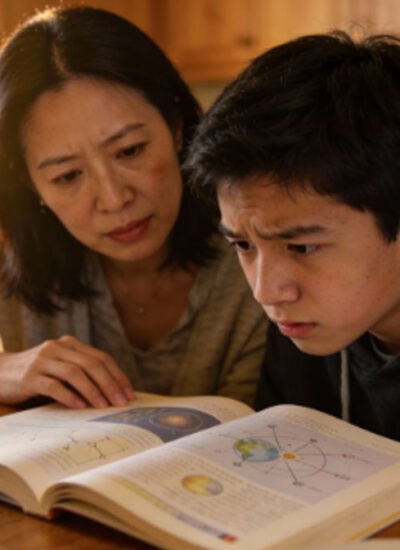
 Your kid sailed through PSLE science. Maybe even scored AL1 or AL2. You thought science was their strong subject. Then Secondary 1 hits and suddenly they’re coming home confused, frustrated, and asking questions you definitely can’t answer.
What happened?
If this sounds like your family right now, take a breath. You’re not alone. This is one of the most common struggles I hear about from parents, and after teaching thousands of students through this exact transition, I can tell you it’s completely normal. More importantly, it’s fixable.
The Jump Nobody Warns You About
Here’s what most parents don’t realize. Primary school science and secondary school science are almost like different subjects wearing the same name.
In primary school, your child learned concepts. Plants need sunlight. Water evaporates. Magnets attract. The questions tested whether they understood these ideas and could explain them using keywords.
Secondary school science? Completely different game.
Suddenly there’s Physics with calculations, formulas, and abstract concepts like velocity and acceleration. There’s Chemistry with atomic structures and equations that need balancing. Biology gets deeper into cell processes your child can’t see or touch.
The jump isn’t gradual. It’s like going from swimming in a pool to being dropped in the ocean.
Why Smart Kids Suddenly Struggle
I’ve taught students who scored AL1 for PSLE science and then failed their first Secondary 1 science test. Their parents were shocked. “But they were so good at science!”
Here’s what’s actually happening.
The memorization safety net disappears. In primary school, you could memorize model answers and do reasonably well. Secondary school throws new scenarios at students constantly. Pure memorization doesn’t cut it anymore.
Math sneaks into science. Your child might understand the concept of speed perfectly. But when they need to manipulate formulas and calculate with proper units, that’s a different skill. Many students who are confident in science concepts panic when numbers appear.
The content volume explodes. Primary science covers maybe 15-20 main topics over four years. Secondary 1 and 2 alone cover that much in half the time, and the depth is way more intense.
Abstract thinking becomes essential. Atoms. Electrons. Forces you can’t see. Energy transfers. These aren’t things your child can observe directly. They need to visualize concepts that exist only in diagrams and equations.
Signs Your Child Is Struggling (Even If They Won’t Admit It)
Teenagers aren’t always upfront about academic struggles. Pride kicks in. They don’t want to seem “stupid.” So watch for these signs:
- Homework takes twice as long as it should
- They avoid talking about science class
- Test papers mysteriously disappear before you can see them
- “I don’t know” becomes the answer to every science question you ask
- They’re confident about other subjects but suddenly “hate” science
- Last-minute panic before every science test
If you’re seeing three or more of these, there’s likely a bigger problem brewing than your child is letting on.
The Kitchen Table Reality Check
Want to know how much trouble your child is actually in? Try this simple test over dinner.
Ask them to explain one concept they learned recently in science class. Not recite a definition. Explain it like they’re teaching a younger sibling.
If they can do this clearly, they’re probably managing okay.
If they stumble, use vague words like “stuff” and “things,” or get frustrated and say “it’s complicated,” that’s a red flag. They might be attending class and copying notes but not actually understanding what’s happening.
This isn’t about catching them out. It’s about knowing where they really stand so you can help before a small gap becomes a massive crater.
What Doesn’t Work (But Parents Keep Trying)
Let me save you some time and frustration.
Telling them to “just study harder” doesn’t work. If they don’t understand the concepts, studying the same confusing notes for longer hours just makes them more frustrated. It’s like asking someone who can’t swim to swim harder.
YouTube videos alone don’t work. Yes, there are great science videos online. But watching isn’t the same as understanding, and understanding isn’t the same as being able to apply concepts to exam questions. Videos can supplement learning, but they can’t replace structured teaching.
Your old textbooks definitely don’t work. I know you aced O-Level science back in the day. But the syllabus has changed significantly. Topics have been added, removed, and reshuffled. Teaching methods have evolved. What worked for you in 1995 or 2005 might not be relevant anymore.
Last-minute intensive revision doesn’t work. Cramming the week before exams might have worked for some primary school tests. Secondary school science builds on itself. Miss one foundational concept and everything after becomes shaky. You can’t cram understanding.
What Actually Helps
Okay, enough about problems. Let’s talk solutions.
1. Identify the Real Gap
Before throwing resources at the problem, figure out where exactly your child is stuck.
Is it the concepts themselves? They don’t understand what’s being taught.
Is it the math component? They understand the concept but struggle with calculations.
Is it application? They know the theory but can’t apply it to exam questions.
Is it study habits? They’re not reviewing regularly or effectively.
Different problems need different solutions. A child who doesn’t understand atomic structure needs concept teaching. A child who understands it but can’t answer exam questions needs technique practice.
2. Address Foundation Gaps Early
Secondary science builds like a tower. Each topic rests on earlier ones. If your child has gaps in foundational topics, everything built on top will be wobbly.
Don’t just focus on what they’re learning now. Check if they’re solid on prerequisite topics. Sometimes the reason a Sec 2 student can’t grasp chemical bonding is because they never properly understood atomic structure in Sec 1.
Going back to fill gaps feels like moving backward. It’s actually the fastest way forward.
3. Make Connections to Real Life
Abstract concepts stick better when connected to things your child can see and experience.
Physics: Talk about forces when you’re driving. Why does everyone lean forward when you brake suddenly?
Chemistry: Discuss what’s actually happening when you cook. Why does egg white change from transparent to white? That’s protein denaturation.
Biology: Your teenager is experiencing puberty. The hormonal changes they’re going through? That’s their biology syllabus happening in real time.
These conversations don’t replace formal learning, but they build mental hooks that make classroom content stick.
4. Get the Right Support Before Crisis Mode
Here’s where I’ll be direct with you. If your child is struggling, waiting to see if they’ll “figure it out” usually makes things worse.
The gap between primary and secondary science catches many students off guard. Without proper guidance, small confusions snowball into major gaps. By the time parents realize there’s a serious problem, their child is months behind and completely demoralized.
Finding top secondary science tuition early in the struggle, not after multiple failed tests, gives your child time to build proper foundations. The right support helps them understand the concepts, not just memorize for tests, and teaches them how to approach the new style of questions they’re facing.
Look for programs that specifically address the primary-to-secondary transition. Teachers who understand this jump can target exactly where students typically struggle and build confidence before it erodes completely.
5. Create a Sustainable Study Routine
Secondary school science can’t be studied the night before like some primary school subjects. Your child needs consistent, spaced review.
Here’s a simple framework that works:
Same day: Review notes briefly after school, just 10-15 minutes to reinforce what was taught.
Weekend: Go deeper on the week’s topics. Try practice questions. Identify what’s still confusing.
Before tests: Review should be revision of familiar material, not learning everything from scratch.
This might sound obvious, but most struggling students aren’t doing any of this. They’re looking at science content for the first time during revision week and wondering why nothing makes sense.
6. Normalize Asking for Help
Many teenagers resist asking for help because they think it makes them look dumb. Especially if they were high achievers in primary school.
Reframe this for your child. The smartest students are the ones who identify their gaps early and get help. Waiting until you’re drowning isn’t brave, it’s just inefficient.
Whether it’s asking the school teacher after class, forming study groups with friends, or getting external support, seeking help is a skill that will serve them well beyond secondary school.
The Three Sciences: What’s Different About Each
If your child is in upper secondary and has chosen their subject combination, each science has its own challenges.
Physics is math-heavy. If your child struggles with mathematical manipulation and problem-solving, physics will feel hard even if they understand the concepts. The key is practice, practice, practice with calculations until formulas become second nature.
Chemistry requires both understanding and memorization. Your child needs to understand why reactions happen, but they also need to memorize equations, properties, and sequences. It’s a balance between the two.
Biology is content-heavy. There’s a lot to remember, from processes to diagrams to definitions. But it’s not just memorization. Modern biology exams test application and data analysis heavily. Your child needs to understand concepts well enough to apply them to unfamiliar scenarios.
Knowing your child’s strengths helps you provide the right support. A math-strong child might thrive in physics but need more help with biology’s content load. A strong memorizer might do well in biology but struggle with physics problem-solving.
When to Be Concerned vs When to Wait
Not every bad test means your child needs intervention. Some fluctuation is normal as they adjust to secondary school.
It’s probably okay if:
- They had one or two bad tests but generally understand the material
- They can identify what went wrong and have a plan to improve
- Their overall trend is stable or improving
- They’re still engaged and willing to work at it
Time to take action if:
- Scores are consistently dropping over multiple tests
- They can’t explain basic concepts from earlier topics
- They’ve given up and say they’re “just bad at science”
- They’re avoiding homework or pretending it doesn’t exist
- The struggle has spread to affect other subjects or their wellbeing
Trust your parental instinct. You know your child. If something feels off, it probably is.
A Note on Pressure and Expectations
I want to say something important here.
Yes, O-Levels matter. Yes, science grades can affect streaming and future options. But your child is more than their science score.
Some students genuinely aren’t wired for science, and that’s okay. Not everyone needs to become a doctor or engineer. If your child is working hard, getting proper support, and still finding science genuinely difficult, that’s information about their strengths and interests, not evidence of failure.
The goal isn’t to force every child to score A1 for combined science. The goal is to help them learn effectively and achieve their personal best, whatever that looks like.
Pressure that motivates is helpful. Pressure that paralyzes isn’t. Know the difference for your child.
What Your Child Actually Needs From You
After thousands of conversations with students, here’s what they say helps most from parents:
Patience. They’re struggling and they know it. Frustration from you makes it worse.
Practical support. Help them find resources, arrange tuition if needed, create a good study environment.
Belief in them. Not empty “you can do it” cheerleading, but genuine confidence that they can improve with effort and the right approach.
Reduced comparison. They don’t need to hear about how their cousin aced science or how you were top of your class. They need to focus on their own progress.
Space to fail and recover. One bad test isn’t the end of the world. Help them learn from it and move forward rather than dwelling on it.
Moving Forward
Secondary school science is a genuine jump in difficulty. If your child is struggling, it doesn’t mean they’re not smart or not trying. It means they need support navigating a transition that catches many students off guard.
Start by understanding where the actual gaps are. Address foundational issues before they snowball. Get the right support early rather than waiting for crisis mode. And create sustainable study habits that prevent last-minute panic.
Most importantly, remind your child, and yourself, that this is a temporary challenge. With the right approach, proper support, and consistent effort, students who struggled initially with secondary science can absolutely turn things around.
The transition is hard. But it’s not impossible. And the skills they build overcoming this challenge, problem-solving, asking for help, persisting through difficulty, those will serve them well beyond any science exam.



Leave a Reply