
 Walk into any mathematics classroom and you’ll see the same problem playing out. A teacher stands at the front explaining quadratic equations to 30 students. Five already understood this last week and are bored out of their minds. Another five are completely lost because they never properly grasped basic algebra. The remaining twenty are somewhere in the middle, half-listening, half-confused.
This is what we call “teaching to the middle,” and it’s been failing students for decades. It’s not anyone’s fault really. How can one teacher possibly address 30 different learning speeds, 30 different sets of prior knowledge gaps, and 30 different ways of processing information? They can’t. That’s just reality.
Private tuition exists because classroom mathematics instruction has fundamental limitations that can’t be fixed by better teachers or smaller class sizes alone. But here’s the thing: not every student needs private tuition, and not all private tuition is worth the money parents spend on it.
Why Classrooms Can’t Do Everything
Let’s be honest about what happens in schools. Teachers face enormous pressure to cover specific content by specific dates. There’s a syllabus, there are exams, and there’s no time to go back and fix gaps from previous years. A student who never really understood fractions in primary school? That problem doesn’t get solved in secondary school. It just gets bigger.
The student struggles with algebraic fractions. Then rational expressions. Then calculus involving anything with fractions. Each new topic builds on the shaky foundation, and eventually the whole thing collapses. The teacher sees the student struggling but can’t stop the entire class to remediate one person’s gaps from three years ago.
Research from places like Stanford University backs this up. Mathematics learning is cumulative. Miss one crucial concept and everything built on top of it becomes impossibly difficult. Classroom instruction moves forward regardless of whether everyone’s keeping up, which means students who fall behind rarely catch up on their own.
Signs Your Kid Actually Needs Private Tuition
Some parents throw money at tuition the moment grades slip slightly. That’s often unnecessary. But certain red flags genuinely indicate a student needs individual help.
Consistent poor performance despite genuine effort means something’s fundamentally wrong. The student isn’t lazy. They’re trying. But classroom instruction isn’t clicking for whatever reason. That gap won’t close by itself.
Watch for students who can follow along during lessons but freeze during homework or tests. They’re mimicking understanding without actually getting it. That’s a teaching problem, not a student problem. They need someone to explain concepts differently until real understanding develops.
Math anxiety is another massive indicator. When students say “I’m just bad at math” or panic at the sight of equations, that’s accumulated confusion creating psychological barriers. Regular classrooms can’t address this. You need individualized support that rebuilds confidence through small, manageable successes.
Students switching between education systems almost always benefit from private help. Moving from local curriculum to IB, or jumping from O-Levels to A-Levels, introduces huge conceptual leaps. Schools assume you’re ready. Often you’re not. Private tuition fills those gaps before they become disasters.
Even high achievers sometimes need private tuition, though for different reasons. They’ve mastered standard content but want exposure to competition problems, alternative methods, and deeper exploration. Classroom time constraints prevent this kind of enrichment.
What Private Tuition Actually Fixes
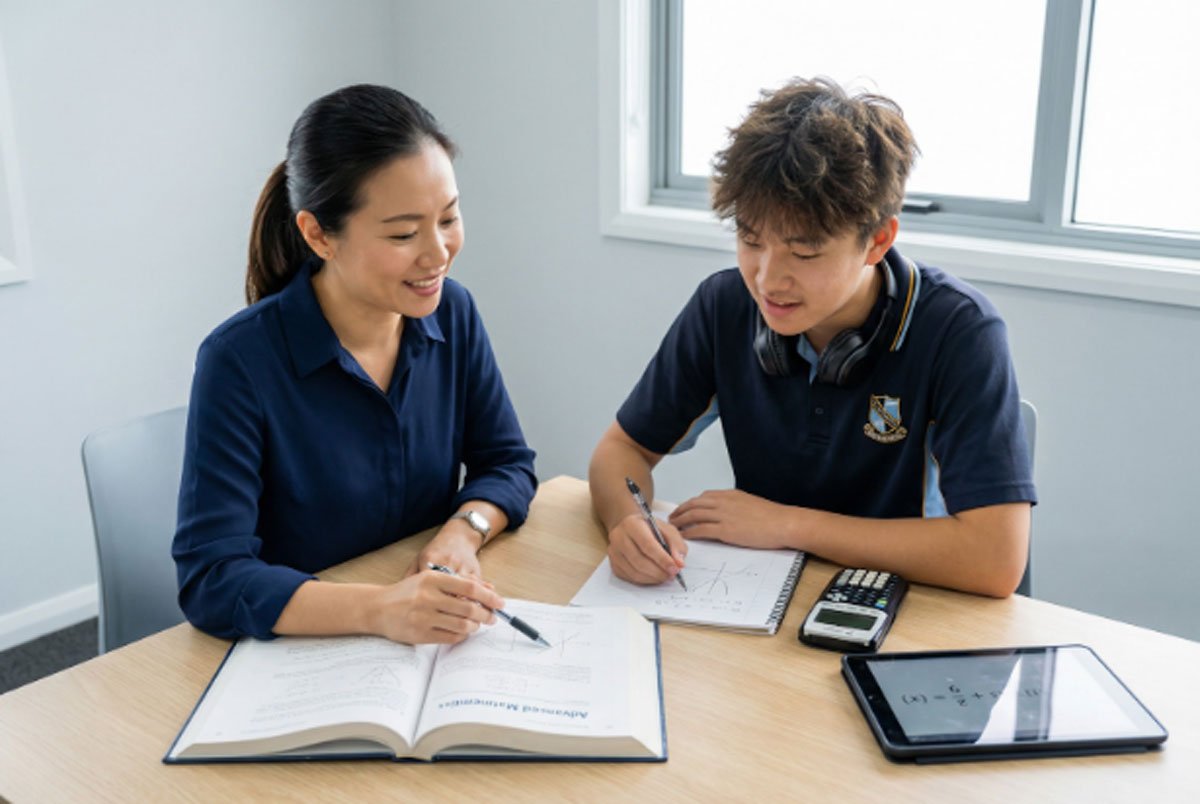
The whole point of private tuition is personalization. A tutor sits down with one student and figures out exactly where understanding broke down. Maybe the student struggles with quadratic equations not because quadratics are hard, but because they never properly learned factoring two years ago. A private tutor can backtrack and fix that specific gap.
Pacing changes completely too. Need three sessions to fully grasp trigonometry? Take three sessions. Already understand coordinate geometry from independent study? Skip ahead. This flexibility doesn’t exist in classrooms serving 30 people simultaneously.
Different students learn differently, which classrooms can’t accommodate. Some need visual diagrams. Others prefer working through algebra symbolically. Some require real-world applications to understand abstract concepts. Private tutors adjust their approach to match how each student’s brain actually processes mathematical information.
Feedback happens instantly too. Make an error during private tuition and the tutor catches it immediately, explains the misconception, and corrects your thinking. In class? Your error might not get noticed until the test comes back two weeks later, by which point the wrong thinking is already ingrained.
Small Groups Work Too
Pure one-to-one isn’t always the answer. Small group tuition with maybe 2 to 8 students offers a middle path. You get way more individual attention than school provides whilst still benefiting from peer interaction.
Hearing another student explain their approach to a problem often helps more than listening to the tutor. There’s something about peer explanation that makes concepts click differently. Plus, explaining your own thinking to others forces you to actually understand it properly. You can’t fake your way through explaining mathematics.
Small groups work especially well for exam prep. You practice under test conditions together, learn time management, observe how others tackle questions. It’s also cheaper than pure private tuition whilst delivering far better results than those massive tuition centres that are basically just second schools.
Whether you need pure one-to-one or small group depends on your situation. Severe foundational gaps or major anxiety? Start with individual attention. Mainly need exam preparation and you’ve got decent understanding already? Small groups probably work fine.
Choosing a Tutor Who Actually Helps
Not all tutors are worth the fees they charge. Parents need to evaluate carefully. Sure, qualifications matter, but teaching ability matters way more. Someone with a PhD who can’t explain things clearly is useless.
Ask about methodology. Good tutors can articulate exactly how they build understanding, identify gaps, and develop genuine mathematical thinking. Be suspicious of anyone who just says “we practice lots of exam questions.” That’s drilling, not teaching.
Get a trial session before committing. Watch how the tutor interacts with your child. Do they adjust explanations when confusion appears? Do they ask questions to gauge understanding? Is there actual chemistry between tutor and student? That relationship matters enormously for learning effectiveness.
Check what resources come with the tuition. Quality private tuition for Maths includes comprehensive materials like curated practice sets, revision summaries, past papers with full solutions, video explanations. These resources extend learning way beyond the hour or two per week of face-to-face time.
Find out about support between sessions. Top tutors answer questions via WhatsApp or Telegram when students get stuck on homework. This prevents small confusions from snowballing into major problems. Weekly-only contact severely limits how much progress students can make.
Red Flags That Scream “Avoid”
Some warning signs indicate tuition that won’t deliver results. Tutors obsessed with drilling past papers without building conceptual understanding create fragile knowledge. Students might score well on familiar question types, then completely collapse when examiners change the format slightly.
Watch out for totally inflexible teaching. A tutor using the exact same method for every student is just running a mini-classroom in expensive one-to-one format. Private instruction should adapt constantly to student needs. If it doesn’t, you’re wasting money.
Be skeptical of wild promises. “Guaranteed A grade” or “improve 3 grades in one month” suggests either lying or dangerous overconfidence. Real tutors discuss realistic timelines based on current ability, gaps that need filling, and time available before exams.
No progress tracking is another concern. Quality tutors monitor development systematically, spot persistent weaknesses, adjust instruction accordingly. Those who just show up to teach without structured planning aren’t delivering much value.
How to Tell If It’s Working
Grades improve, obviously, but that shouldn’t be your only measure. Listen to whether your child can explain mathematical concepts in their own words. Real understanding means you can articulate ideas. Memorized procedures just produce mechanical repetition without comprehension.
Watch their confidence with unfamiliar problems. Do they attempt new questions independently or immediately claim they can’t do it? Growing confidence and willingness to tackle challenges shows developing competence, not just exam preparation.
Pay attention to how they feel about maths. Effective tuition reduces anxiety and builds engagement. If grades improve but your child still dreads the subject, the tutor is probably too focused on examination technique without addressing underlying confidence issues.
Ask the tutor for detailed feedback regularly. Quality tutors communicate about progress, persistent difficulties, and areas needing continued work. If you’re just getting bills without real communication about development, that’s a problem.
Think Long Term, Not Just Next Exam
Yes, private maths tuition costs serious money. But think of it as educational investment, not recurring expense. Strong mathematical foundations pay dividends throughout school and beyond.
Students who get excellent maths instruction during secondary school often need minimal help later because they’ve learned how to learn mathematics. That skill transfers to advanced content way more effectively than memorizing specific formulas or procedures.
According to research from educational psychology, students developing deep mathematical understanding show better problem-solving abilities across all subjects. Mathematical thinking improves logical reasoning, analytical skills, and structured approaches to complex problems. Those benefits extend far beyond passing maths exams.
I’ve seen students who received quality private tuition return years later for occasional consultations at polytechnic or university level. Not because they’re struggling, but because they value expert guidance. That ongoing relationship suggests the tuition built lasting competence rather than temporary grade inflation.
Making the Call
Deciding whether your child needs private maths tuition requires honest assessment. Is classroom instruction genuinely insufficient, or does your kid just need to work harder? Are there actual learning gaps preventing progress, or is this primarily a motivation issue?
Consider the trajectory without intervention. Will they catch up eventually? Maintain current performance? Fall further behind? If the honest answer is “fall further behind,” earlier intervention prevents compounding problems.
Think about your child’s learning preferences too. Some thrive with individual attention and customized pacing. Others prefer peer interaction and might do better in small groups. There’s no universal right answer. It depends on personality and learning style.
Private mathematics tuition represents a significant commitment of money and time. When you find quality instruction and your child genuinely needs it, the transformation in mathematical competence, confidence, and academic trajectory can be remarkable. Just choose carefully, monitor results honestly, and adjust if things aren’t working.




Leave a Reply